
Researchers at the University of Twente and Radboudumc developed a small screw-like robot that can be steered through brain tissue using an external magnet.
The team envisions that the robot will one day travel through the bloodstream, drill through an artery wall and enter brain tissue to access hard-to-reach lesions, blood clots, tumors and vascular malformations without having to surgically open the skull.
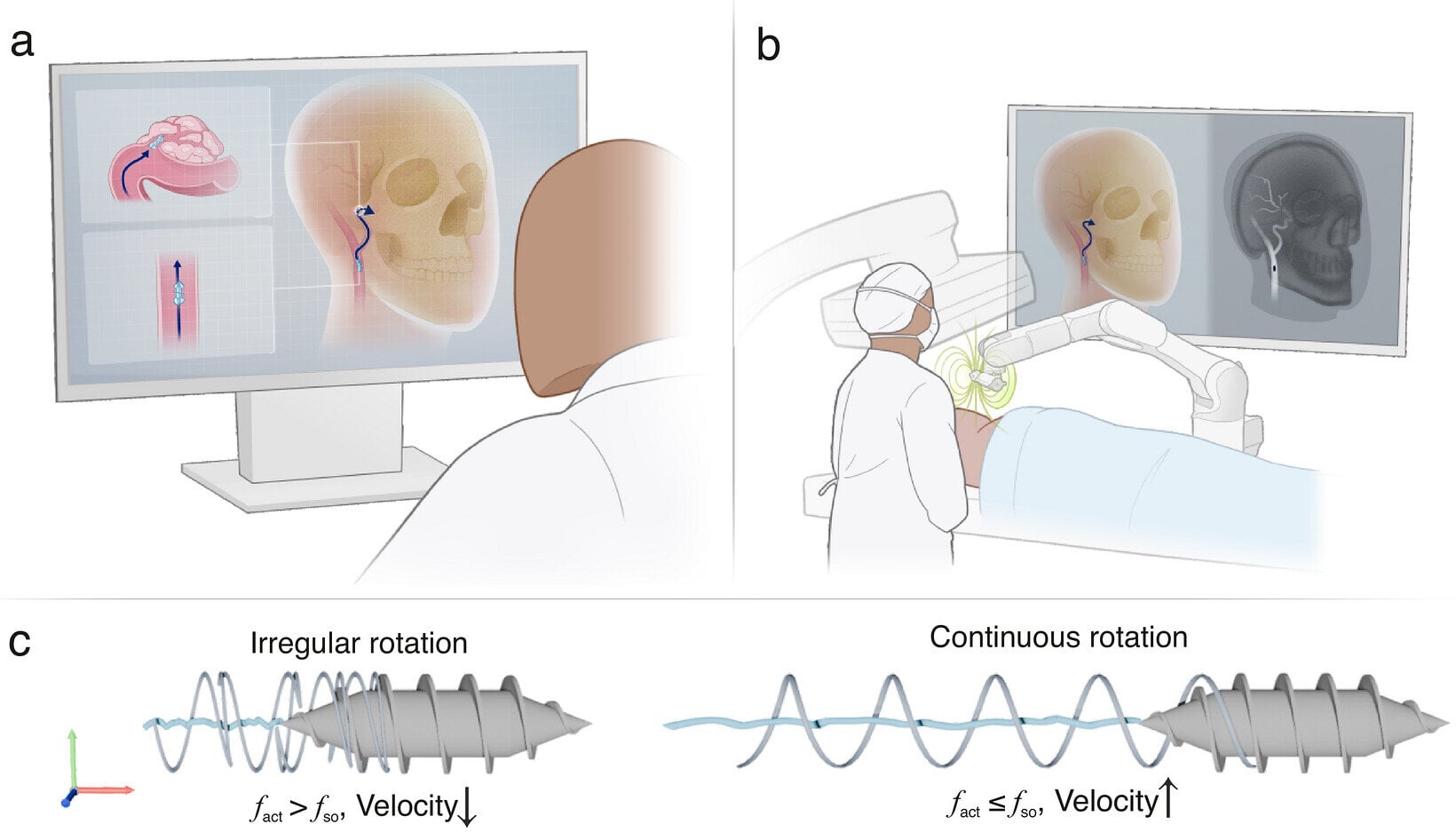 Source: Advanced Science (2026). DOI: 10.1002/advs.77011
The magnet spins the robot, enabling it to drill through tissue toward these targets. Yet, the robot can only keep up with the magnet up to a certain speed, known as the step-out frequency, beyond which it may slip, stall or move unpredictably.
Now, the team can pinpoint that moment with the new model, which combines robot size, magnetic strength and tissue stiffness to predict when a magnetic robot will stop following a rotating magnet.
When trialed, the threshold dropped from roughly 30 rotations per second in soft tissue to less than one rotation per second in the stiffest tissue tested. The model was validated in gelatin and sheep brain tissue, where blood flow further reduced the threshold from about 1.8 rotations per second to below 0.45 rotations per second. The robot drilled through brain tissue at 0.2 mm per second and retraced its path at 2.9 mm per second, while real-time tracking enabled it to reach targets in the brain-like gel with sub-millimeter precision.
An article detailing the work, “Performance Estimation and Ex Vivo Validation of Untethered Magnetic Robots in Soft Tissue,” appears in the journal Advanced Science.
