
Technologies sometimes introduce problems that they themselves have to solve. Quantum technology is an excellent example of that. Powerful quantum computers promise to make most modern cryptographic algorithms obsolete, exposing all kinds of sensitive information that passes on the internet, from bank details to military secrets.
The solution to that problem appears to be the quantum internet, which utilizes some of the most counterintuitive features of quantum mechanics – superposition and entanglement – to build unhackable communications lines. But first, engineers have to develop the tools to do it, and that is still a work in progress.
The transition to quantum
Modern computer network security is reliant on using a type of algorithm that requires the factoring of extremely large numbers into their prime components. This is extremely difficult for a standard computer – the traditional expectation is that it would take billions of years – but relatively trivial for a quantum computer. The eventual creation of a quantum computer powerful enough to break the most common modern cryptography algorithms, like RSA, is known in the cybersecurity world as “Q-day”, and is seen by many as the end of the old order.
As their response, quantum security experts have come up with a new cryptographic methodology, called Quantum Key Distribution (QKD). It utilizes two “features” of quantum theory to make the information going across a network essentially unreadable - or at least give the users knowledge when someone is attempting to do so.
The first is the observer effect - a consequence of the famous Heisenberg Uncertainty Principle, and arguably the most famous feature of quantum mechanics. A qubit – the fundamental feature of a quantum computing system – is capable of holding three states – 0, 1, and a “superposition” of both zero and one at the same time. While it is in a “superposition” it is physically impossible to know what the value is. However, when the qubit is observed, it must take the value of either a 1 or a 0 like a traditional computing system.
When a qubit is transferred along a communications line (typically a fiber optic cable), it is sent in a state of superposition. So if a hacker attempts to “observe” (i.e. read) the value of the qubit, it immediately loses its superposition in a process called “decoherence”, and the network then knows that the system has been compromised.
So instead of observing the value of the qubit on the system, could a hacker just copy its superpositional state and observe it elsewhere, outside of the protective eyes of the original network? No, because of another feature of quantum mechanics known as the No-Cloning Theorem. According to this theory, it is impossible to create a perfect copy of qubit without knowing its state first. Combining these two features - essentially data that can’t be read and can’t be copied – make the quantum network unhackable, or at least make the users of the network aware when it is attempting to be hacked.
Engineering challenges
However, to create these unhackable networks, they must be implemented in the real world. Doing so will require completely different infrastructure from what typically underpins the modern internet. However, the new quantum infrastructure wouldn’t have to replace what already exists – it would likely act in parallel as a type of security blanket around current internet communication. But a lot of work must be done on a lot of different pieces of that infrastructure first.
One of the most important pieces of that infrastructure is a single-photon source. These are needed to transmit the quantum information by manipulating their properties, such as their polarization. Since this is an actual quantum property, it abides by the laws of quantum mechanics that make it so difficult to hack. There are two different types of single-photon sources – probabilistic sources and deterministic sources. Probabilistic sources use a technique called Spontaneous Parametric Down-Conversion to “stimulate” a crystal to split out a pair of entangled photons. A deterministic source, on the other hand, attempts to isolate a single quantum system, such as a “nitrogen vacancy” in a diamond crystal lattice that, when excited by a laser, emits a photon.
When the qubits are transmitted, they need to be through an entirely passive channel, as any active component on the channel will break the observer rule, defeating the anti-hacking aspect of the system. Experiments show that quantum and classical data can both be transmitted over the same fiberoptic network, but only over short distances before a “repeater” of some sort is needed.
Once a qubit reaches its destination, there needs to be a single-photon detector that can receive and translate the information in the photon, such as then quantumly stored polarization, into actionable values for the “quantum processor nodes” they are attached to. These single-photon detectors are typically used in fields like astronomy and dark matter detection but have become advanced enough to not be overwhelmed by false-positive events that had overwhelmed previous generations of the technology.
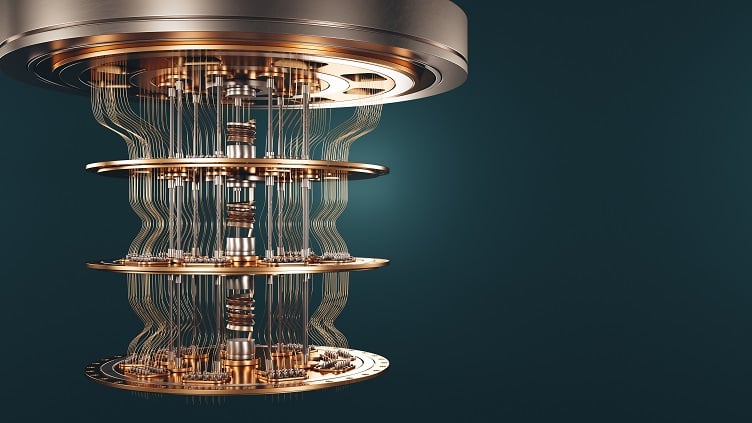
 A quantum compute concept. Networks built on quantum computing are coming but there are still large infrastructure and technical challenges ahead. Source: PAOLO/Adobe Stock
The tyranny of distance
Perhaps the single biggest hiccup in the development of quantum communications systems is the difficulty in dealing with distance. Traditional communication lines can simply use repeaters to receive and then retransmit the information being passed down a line.
However, this would break the encryption of quantum systems, so such a solution is not feasible. Photons still get “lost” in fiber optic cables though and do so in increasing numbers over longer distances. Even if a photon does make it all the way to the end station, there is a chance that it could “decohere” – i.e. lose its quantum state that was the defining feature of the communication channel. Even something as simple as a passing car over an underground fiber optic cable could cause a quantum signal to decohere.
To solve this problem, engineers are working on “quantum repeaters”. In this architecture, a quantum network is broken into shorter, more manageable chains that are linked together by specialized equipment. Each node in the chain contains a quantum repeater that uses another technique called a Bell State Measurement to induce a state known as “entanglement swapping” between two qubits.
This process breaks the entanglement between the qubit from the originating source and the repeater and turns syncs it with the qubit that was from the receiver that was originally entangled with one in the repeater – essentially it bonds the two chains together without ever accessing or copying the information stored in the qubits. This allows infinite chaining of communication links all without losing the integrity of the quantum signal to either distance or decoherence.
A quantum future
If this all still sounds like science fiction, it largely is. There are massive engineering and technical hurdles to overcome before the quantum communications future becomes a reality. Improvements in hardware are only one part of it - investment in infrastructure would be a significant speed bump as well. None of the systems described here are cheap. And there are also alternatives, such as Post-Quantum Cryptography, which aims to use traditional cryptographic methods to make codes that are impossible for even a quantum computer to break.
But ultimately, the advantages of quantum computing and quantum communication are too big to ignore.
Despite the difficulty in training engineers and scientists to work on them, and the extremely long lead times to any profitable business model for most enterprises working in the sector, there will one day be a “quantum internet” supported by quantum computers that enable unheard of processing power and secure communications. It will undoubtedly have its own problems that it has to solve, but part of the work of engineers everywhere is solving those kinds of problems - it will only be a matter of time before they do.
About the author
Andy Tomaswick is an engineer and freelance writer who’s passionate about education, space exploration and making the world better through technology. When not engineering or writing something, he spends time with his family or running in circles and throwing plastic discs at people to stay in shape.
