
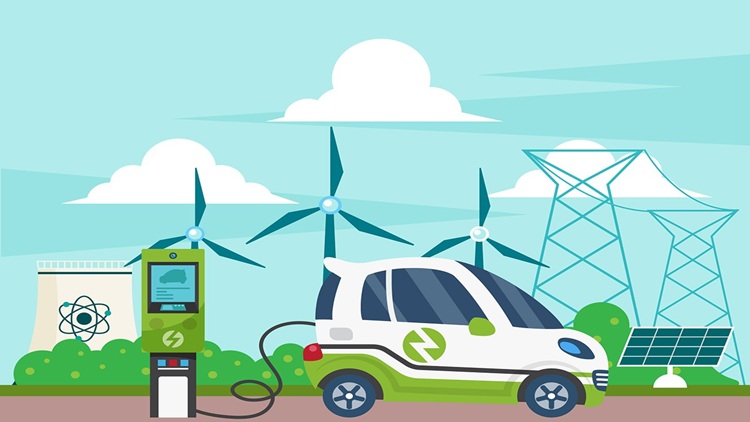
Vehicle-to-grid (V2G) systems permit electric vehicles (EVs) to both extract electricity from and return power to the grid. This bi-directional energy flow converts EVs from passive loads into active energy resources, significantly contributing to the flexibility, stability and sustainability of smart grids. They enable EV batteries to release stored electricity back into the power grid during periods of peak demand or instability.
Main components
Bidirectional chargers
Bidirectional chargers are essential components of any V2G system. In contrast to traditional EV chargers that facilitate unidirectional electricity flow from the grid to the vehicle, bidirectional chargers enable both the charging of the vehicle and the discharging of power from the vehicle's battery back to the grid. These chargers facilitate the conversion of alternating current (AC) from the grid to direct current (DC) for the battery, and vice versa, utilizing power electronic converters. High efficiency and a solid design are essential, as these chargers must endure frequent power cycles. Depending on their layout, they may be on-board (integrated into the vehicle) or off-board (placed at the charging station), each offering distinct advantages regarding cost, space and control.
Communication infrastructure
Reliable and standardized communication is vital for V2G systems to function effectively. This includes secure, low-latency communication between the EV, the charging station, the energy management system and the grid operator. Communication protocols such as OCPP (Open Charge Point Protocol) and ISO/IEC 15118 define how vehicles and chargers exchange information, including charging preferences, state-of-charge, availability and pricing data. These protocols support plug-and-play interoperability, vehicle authentication and even advanced services like "plug and charge." A robust communication infrastructure ensures that energy flow decisions can be made dynamically and in alignment with real-time grid requirements.
Smart meters and energy management systems (EMS)
Smart meters and EMS enable monitoring, measurement and control of electricity usage and flow between the grid and EVs. Smart meters track energy consumption in real-time and support dynamic pricing, which is essential for time-of-use billing in V2G operations. Meanwhile, the EMS ensures optimal decision-making about when to charge or discharge EV batteries based on grid conditions, energy prices and vehicle availability. These systems often use algorithms to predict energy demand and supply patterns, helping to optimize the participation of EVs in grid services while preserving battery life and user convenience.
Aggregators and cloud platforms
An individual EV has limited energy capacity, but when hundreds or thousands of EVs are grouped and coordinated, they form a Virtual Power Plant (VPP). This is where aggregators come in. Aggregators are third-party platforms or service providers that coordinate the actions of multiple EVs to participate collectively in energy markets or provide ancillary grid services like frequency regulation and load balancing. They use cloud-based platforms that gather data from individual EVs and chargers, process it using optimization algorithms and send commands to dispatch energy in response to grid needs. These platforms often integrate artificial intelligence (AI) and machine learning for predictive analytics and smart scheduling.
Grid interface and utility control systems
At the grid level, V2G systems must interface with utility control centers and grid management systems. These interfaces allow utilities to monitor the contribution of V2G assets to grid operations and to request services when needed. For instance, during a sudden drop in renewable generation, the utility might signal aggregators or EMS platforms to discharge EV batteries for short-term frequency support. Grid interface tools must also ensure that V2G operations are compliant with power quality standards and do not destabilize the grid. These systems are usually integrated with SCADA (Supervisory Control and Data Acquisition) and DERMS (Distributed Energy Resource Management Systems) for grid-wide coordination.
Real-world applications
Nissan and Fermata Energy (U.S. and Japan)
Nissan, in partnership with Fermata Energy, has launched several V2G pilot projects using the Nissan Leaf, one of the few commercially available EVs with built-in bidirectional charging capability. These projects are taking place in the U.S. and Japan, focusing on both grid services and building backup power. For example, in some U.S. trials, Leaf vehicles are used to reduce electricity bills by discharging into buildings during peak rate periods. In Japan, the emphasis is also on disaster resilience, where parked EVs can provide emergency power during blackouts caused by earthquakes or typhoons.
School buses as grid assets — California
In California, V2G is being deployed with electric school buses, turning them into mobile energy storage units. During the day, when buses are idle, they can feed energy back to the grid. This not only reduces school district energy costs but also supports the grid during peak hours. Companies like Blue Bird and Thomas Built Buses are leading this effort in collaboration with utilities like Pacific Gas & Electric (PG&E) and Southern California Edison (SCE). This use case is particularly effective because school buses have predictable schedules and large batteries.
University of Delaware — V2G Pioneer Project
The University of Delaware is widely recognized as one of the pioneers of V2G research and deployment. In collaboration with PJM Interconnection (a regional transmission organization), the university created a pilot project using a fleet of EVs (initially modified EVs like the BMW Mini E) to provide frequency regulation services to the power grid. This project proved that EVs could respond quickly and reliably to grid commands, effectively acting as small, distributed power plants. It was one of the first demonstrations that showed how V2G could generate revenue for vehicle owners by participating in ancillary service markets.
Conclusion
V2G systems allow EVs to both consume power from and return power to the grid. Their real-world applications demonstrate the growing maturity and diversity of V2G deployments. They reflect how V2G can serve not only technical goals — such as grid stability and peak shaving — but also economic, environmental and social objectives, such as cost savings, renewable energy integration and resilience during disasters.
