
Vibration sensing to extract meaningful data from places where traditional microphones, cameras or direct electrical measurements are no longer sufficient is gaining traction.
This includes capturing mechanical data through devices like drone motors, ear bud headphones or even handheld devices.
At Sensors Converge 2026, UpbeatTech showcased how its microelectromechanical systems (MEMS)-based vibration sensor built on TSMC’s 22 nm process technology is used across a variety of these devices.
These sensors, with no traditional transistors or mechanical components in the signal path, support a frequency range of up to 20 kHz with a high signal-to-noise ratio of about 60 dB and sensitivity about 15 dB.
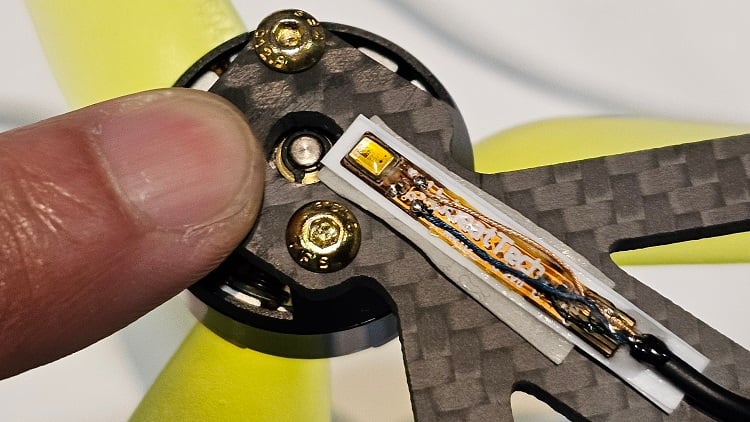
UpbeatTech CEO Jerry Chen demonstrated how its tiny MEMS vibration sensor is used to monitor drone motors in flight to monitor for any potential fluctuations that could cause a crash.
“When a drone is carrying something like a $500 package, you want to know if something goes wrong in transit,” Chen said during an interview at Sensors Converge. “Without a sensor like this, you don’t have visibility into vibration or mechanical issues.”
The vibration sensors monitor the rotor in real time, showing a frequency spectrum. As higher speeds were achieved it pushed the frequency response, demonstrating the system’s ability to track mechanical behavior dynamically.
“This is the analysis done by the chip,” Chen said. “Without a sensor this small and sensitive, you can’t really monitor rotor behavior like this.”
Other vibration use cases
Chen said that while drone rotor monitoring is one use for UpBeatTech’s sensors, the company’s largest production volume for the technology is in headset devices, particularly clip-on style Bluetooth headsets used in communication.
Vibration sensors use dual fusion combining an air microphone with a bone conduction sensor placed near the ear. The system processes both inputs through a Bluetooth chip running a noise reduction algorithm.
 Pocket’s digital recording device that can be attached to the back of a smartphone that captures voice from near and far distances. Source: Pocket “The system fuses the inputs and produces a much clearer voice signal from noisy environments,” Chen said.
Another demonstration at Sensors Converge 2026 from Chen came in the form of the recording device from San Francisco-based Pocket. This device that can attach to the back of a smartphone is designed to capture conversations through passive audio capture. It records both nearby speech and distant voices by capturing vibration signals through the device body, case and components, Chen said.
“It records everything,” Chen said. “Including your local voice and the person from a distance.”
Chen added that the device relies on highly sensitive vibration detection rather than conventional far-field microphones.
Future expansion
UpbeatTech is not just limiting itself to consumer devices and drones as it sees audio and vibration MEMS-based sensors playing a role in robotics and industrial applications.
Such applications might include ultra-small vibration monitoring systems for equipment health and early fault detection in wafer production environments, which may be a boon for the company, according to Chen.
“If transmission has something wrong, you don’t want to wait until it breaks,” Chen said. “That’s a lot of money at stake.”
In robotics, vibration and friction sensing is gaining momentum where it can be used to detect grip strength, slippage and tactile interaction.
“For robots, how do you know if something is slipping?” Chan said. “You need friction sensing, not just pressure sensing.”
