
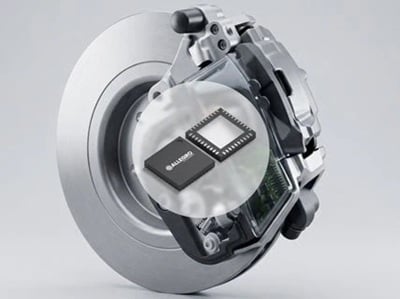
Allegro MicroSystems, Inc., a developer of power and sensing solutions for motion control and energy-efficient systems, has introduced the A81415, the industry's first ASIL-D-certified Power Management IC (PMIC) to integrate a wheel-speed sensor interface. The new device provides electromechanical braking (EMB) designers with a substantially simplified, single-chip power and sensing foundation for next-generation brake-by-wire systems.
Brake-by-wire is fast becoming a foundational chassis technology in software-defined vehicles. But while much of the automotive industry’s design focus is on centralizing compute platforms, the physical act of stopping a vehicle happens at the wheel. This location places a hard set of demands on corner module electronics to deliver fail-operational power and accurate wheel-speed data in tight spaces that are vibration-prone and thermally stressed — all while meeting the highest functional safety bar.
Today, designers are forced to stitch together generic safety PMICs, separate wheel-speed decoders and clusters of discrete power components. In addition to adding cost and consuming valuable board space, that approach multiplies potential failure points at the exact location where reliability matters most.
One device, built for the task
 Source: Allegro MicroSystems, Inc.
With an on-chip wheel-speed sensor interface (WSSI), the A81415 safety PMIC decodes standard two-level Pulse Width Modulation (PWM), and three-level AK protocols (standard and high-resolution) without complicated analog circuitry or a separate decoder IC. By incorporating a fully integrated buck-boost pre-regulator, five Low-Dropout (LDO) regulators, and a single-inductor architecture that requires no external switches or diodes, the A81415 eliminates up to nine external components and unlocks up to $4 in semiconductor bill-of-materials (BOM) savings per vehicle, delivering meaningful cost advantages at OEM production scale. This unprecedented level of integration opens up more than 50% of usable board space to provide the brake caliper with critical design headroom.
Because the physical layer of the wheel-speed data is handled internally by the PMIC and the decoded data is shared over a Serial Peripheral Interface (SPI), the A81415 trims latency in the safety-critical loop and frees MCU bandwidth for faster braking response. Low-noise power rails are explicitly tuned to power Allegro's XtremeSense TMR angle sensors and ensure the entire commutation and clamping-force signal chain is optimized as one coherent, high-resolution system from wheel to caliper.
The 12 V-to-48 V fast track for corner modules
True brake-by-wire operation requires components capable of surviving the harshest electrical environments. Built on Allegro's proprietary automotive grade-0 process and paired with the APM81815 pre-regulator and 48 V gate drivers, the A81415 forms a complete, fail-operational chipset. This modular approach provides Tier 1 suppliers with a fast track to migrate proven 12 V braking architectures directly to next generation 48 V corner modules without redesign or bulky external transient protection.
“Intelligent chassis systems demand that sensing and power electronics at the wheel act as one,” said Peter Wells, business line director, High Performance Power at Allegro MicroSystems. “Allegro combined our wheel-speed sensing leadership and high-reliability power management expertise into our new PMIC to give our customers a simpler, safer and highly scalable foundation for modern vehicle brake-by-wire."
A81415 features and benefits
- Integrated wheel-speed sensing: On-chip WSSI decodes two-level, PWM, AK and high-definition protocols, eliminating a separate decoder IC.
- Cost and space savings: Eliminates up to nine external components, saving up to $4.00 in semiconductor BOM per vehicle and over 50% of PCB area.
- ASIL-D and AEC-Q100 qualified: Dual watchdogs and built-in fault handling meet the highest safety standards without requiring external protection circuitry.
- 12 V-to-48 V scalable: Operates natively in 12 V systems with a simple upgrade path to 48 V corner modules when paired with the APM81815 pre-regulator.
