
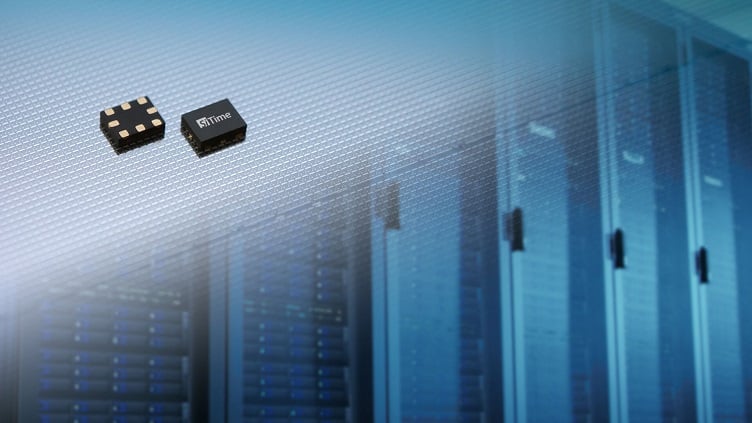
SiTime Corp. has introduced what it claims is a way to increase GPU utilization and compute efficiency in AI data centers through better time synchronization.
This matters because GPU utilization in AI clusters can be as low as 20% to 40%, which is a largely hidden tax on AI infrastructure in data centers, the company said.
Called the Elite 2 Super-TCXO, the timing device delivers sub-nanosecond synchronization, which is claimed to be 10 times better than the target through thermal and short-term stability.
“AI workloads are distributed across GPUs in tightly orchestrated time slots,” said Piyush Sevalia, chief business officer at SiTime. “Even small timing errors force wait cycles to avoid data corruption, and in extreme cases can trigger GPU timeouts and system restarts. Poor synchronization directly caps GPU utilization.”
Sevalia said the Elite 2 Super-TCXO minimizes time errors between GPUs, allowing for higher system utilization, greater throughput and better performance per watt.
SiTime said this timing device targets a $1.5 billion cumulative market by 2030.
“AI networks must operate with extremely high efficiency to fully utilize expensive GPU resources,” said Sameh Boujelbene, VP at market research firm Dell’Oro Group. “As AI back-end infrastructure refreshes at a much faster cadence than traditional non-accelerated infrastructure, time synchronization accuracy becomes increasingly important to sustaining performance across rapidly evolving data center architectures.”
Features of the Elite 2 Super-TXCO include:
- 1 ns time synchronization accuracy
- ±2 ppb/° C dF/dT (frequency temperature slope)
- 6 × 10⁻¹² Allan Deviation (ADEV)
- ±50 ppb frequency stability over -40° C to 105° C
- 3.2 mm × 2.5 mm (8 mm²) footprint
- Digital frequency tuning simplifies timing-aware network design
- Eliminates activity dips and micro jumps inherent in quartz technology
- Resistant to shock, vibration and board bending
