
A bio-inspired robotic fish prototype designed for inspection, hybrid teleoperation and sensor deployment, has been developed by a team from the Centre for Research in Robotics and Underwater Technologies (CIRTESU) at the Universitat Jaume I in Castelló.
According to its developers, the UJIFISH robotic fish features a design that eliminates stress factors such as propellers and high-intensity lighting, while simultaneously maintaining modularity and interoperability.
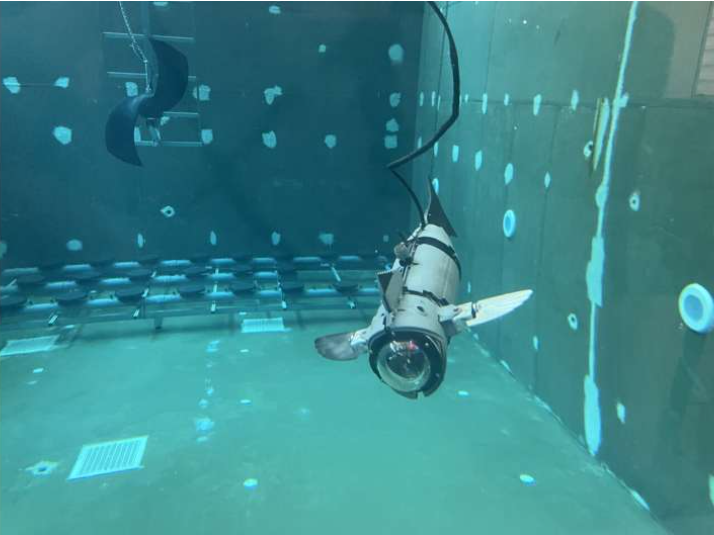 Source: CIRTESU Universitat Jaume I of Castellón
Designed to minimize environmental disturbance and reduce stress in fish, the design of the prototype relied on bio-inspired undulatory propulsion to reduce mechanical noise, hydraulic turbulence and physical disruption.
Further, the system is outfitted with a modular sensing system that enables real-time data acquisition and image transmission along with hybrid communication capabilities through cable or acoustic modem. Additionally, the robot features a panoramic vision system with a 180◦ field of view and it can reportedly operate at depths of up to 20 meters, with remote control ranges of up to 150 meters vertically and 500 meters horizontally.
The UJIFISH also features onboard sensors for continuous measurement of water temperature and depth, as well as the option to include additional sensors for monitoring parameters like salinity, pH, dissolved oxygen and gases. This design allows the robotic fish to perform direct inspection of net structures and to monitor environmental conditions surrounding actual fish.
Trials of the UJIFISH demonstrated high maneuverability and reliable target detection accuracy during net inspection, teleoperation, data collection and sensor deployment, the team concluded.
The robot fish is detailed in the article, “UJIFISH-I: A modular and bioinspired robotic fish for inspection, hybrid teleoperation and sensor deployment in aquaculture,” which appears in the journal Ocean Engineering.
