
HMS Networks announces the launch of Ixxat CAN@net Basic, a streamlined CAN-FD-to-Ethernet-gateway developed to meet the growing demand for simple, scalable and cost-efficient connectivity in industrial and automotive environments.
Modern applications increasingly require seamless communication between distributed CAN networks and Ethernet-based systems. However, engineers often face a trade-off between performance, latency and system cost. Existing solutions tend to be either over-engineered with unnecessary features or too limited to handle real-world CAN FD requirements. CAN@net Basic addresses these challenges by focusing on what matters most: efficient data exchange, low latency and affordability.
Solving engineering challenge I: Balancing latency and jitter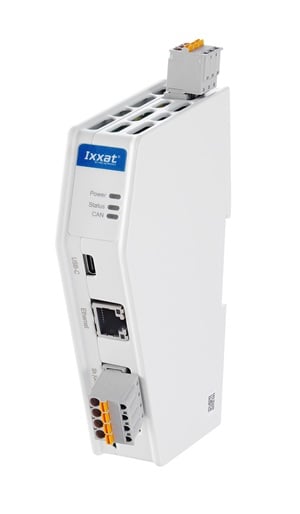 Source: HMS Networks
In many CAN-to-Ethernet systems, transmitting Ethernet frames for every CAN message creates excessive interrupts, leading to high jitter and unstable system performance. Conversely, aggregating data reduces jitter but increases delay. The CAN@net Basic uses UDP/IP communication, significantly reducing protocol overhead and minimizing interrupt load. This enables a balanced approach with low latency and controlled jitter, making it suitable for time-sensitive applications.
Solving engineering challenge II: Scaling distributed systems
In applications where many devices (e.g., test setups or distributed machines) must exchange CAN FD data, physical CAN bus limitations become a bottleneck — especially regarding bus length and node count. CAN@net Basic enables flexible network expansion via Ethernet, allowing engineers to connect distributed systems without being constrained by classical CAN topology limits.
Solving engineering challenge I: Balancing latency and jitter
Source: HMS NetworksIn many CAN-to-Ethernet systems, transmitting Ethernet frames for every CAN message creates excessive interrupts, leading to high jitter and unstable system performance. Conversely, aggregating data reduces jitter but increases delay. The CAN@net Basic uses UDP/IP communication, significantly reducing protocol overhead and minimizing interrupt load. This enables a balanced approach with low latency and controlled jitter, making it suitable for time-sensitive applications.
Solving engineering challenge II: Scaling distributed systems
In applications where many devices (e.g., test setups or distributed machines) must exchange CAN FD data, physical CAN bus limitations become a bottleneck — especially regarding bus length and node count. CAN@net Basic enables flexible network expansion via Ethernet, allowing engineers to connect distributed systems without being constrained by classical CAN topology limits.
Solving engineering challenge III: Reducing cost without compromise
Many users only require a subset of advanced gateway functionality but are forced to pay for full-featured solutions. CAN@net Basic is specifically designed as a cost-optimized alternative, delivering essential functionality at a market-aligned list price of 270 Euros while maintaining industrial-grade performance and quality.
Key technical features
- One CAN CC/CAN FD channel
- CAN data rates of up to 8 Mbit/s
- One Ethernet channel (RJ45)
- ASCII interface mode
- UDP/IP over Ethernet
- USB interface type C, USB 2.0 high-speed (480 Mbit/s)
- Removable push-in connectors
- Galvanic isolation (CAN: 2.5 kV 1 minute; Ethernet: 1.5 kV 1 minute)
- Operating temperature from -25° C to 85° C
- Ingress protection IP20
- DIN rail housing (108 mm x 149 mm x 27 mm)
