
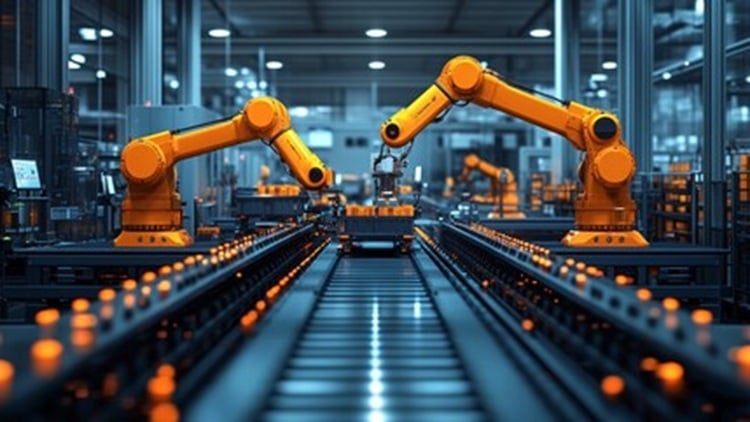
In industrial automation and robotics, flexible cables refer to specially engineered cables designed to withstand constant movement and stress. They are the lifelines of automated systems, enabling the transfer of electrical power, control signals and high-speed data between robot components. Unlike ordinary wires, flexible robotic cables must tolerate repetitive motion, bending and twisting without degradation. They are built to be highly durable – resisting wear, abrasion, extreme temperatures, oils and chemicals – while maintaining reliable electrical performance. Flexible cables also incorporate electromagnetic shielding to preserve signal integrity in electrically noisy factory environments.
In essence, without robust flexible cables, collaborative robots (cobots) and smart factory equipment would suffer frequent downtimes and failures, as standard cables cannot survive the dynamic conditions of these applications. The flexibility and resilience of these components are what allow robotic arms, automated conveyors and moving machines to function seamlessly 24/7 in modern industry settings.
Use cases in cobot and smart factory automation
Flexible cables find use in countless applications across cobots and advanced manufacturing. Below are a few representative scenarios where cable flexibility and reliability are especially critical:
• Cobot arms: Cobots are collaborative robots that frequently include numerous joints (6+ axes) to allow for great dexterity, allowing them to work securely alongside humans. The articulating joints of a cobot arm are the usual conduits for power and sensor cables. These wires need to be able to bend and twist in tight places since the device moves and rotates its parts repetitively. A cobot that is assembling something, for example, could flex its wrist cables thousands of times an hour. The arm can move freely without fear of cable snags or fatigue failures thanks to flexible cables that have a high torsional rating and a tight tolerance for bend radius.
• Industrial 6-axis robots in production lines: Robots with many axes of motion perform welding, painting and material handling in assembly lines for automobiles and electronics. Their movements are tracked by external cable bundles called clothing packs, which are common features of these robots. In the case of welding robots, for instance, the wires that supply power to the torch undergo constant bending and, on occasion, twisting as it approaches a new task. Robots in this situation, whether they are welding or machining, must be able to withstand not only the motion but also the severe environments in which they operate.
• Drag chains and moving machine components: In smart factories, automated machinery such as gantries, linear modules and conveyor systems that use energy chains (cable tracks) to direct cables is utilized. A multi-meter cable chain, for instance, could stretch with each machine cycle on a pick-and-place or CNC router. The internal cables of the chain must be able to withstand constant bending due to its curvature. Here, one will find continuous-flex cables, also known as chainflex cables, which are designed to withstand millions of bending cycles in the drag chain without corkscrewing or core breaking.
• Mobile robots and AGVs: Autonomous mobile robots and automated guided vehicles (AGVs) in factories often include robotic arms or adjustable platforms and travel across facilities. The cables on these systems must withstand constant vibration, movement and bending as the robot navigates and actuates. For instance, an AGV with a lifting arm will have cables running to motors and sensors that flex with each raise/lower action, all while the base is moving over possibly uneven floors. Flexible cables used here are chosen for ruggedness and high cycle life, often with extra reinforcement. They might incorporate aramid fiber or Kevlar strength members to handle tension, and very flexible strain reliefs to prevent any sharp bends at connection points.
All of these applications highlight the same idea: automation would come to a standstill if not for high-quality flexible wires. Engineers make sure that automated machines and collaborative robots can reliably do their jobs every day by using cables that are compatible with the application's motion profile and surroundings.
Challenges and innovations in cable design
As smart factories evolve, the demand on cabling technology continue to increase. Engineers are pushing the boundaries of flexible cable design to address new challenges and enable future innovations:
• Miniaturization and space constraints: Modern production machinery frequently has extremely limited cable routing places, and collaborative robots are shrinking in size as a result. The demand for lighter, smaller cables that can nevertheless withstand flexing is driven by this. Miniature cables with the right amount of pliability are now possible thanks to advancements in insulation (thinner high-strength dielectrics) and conductor technology (using ultra-fine wire strands and new alloys).
• High data throughput and hybrid cable designs: Numerous sensors, vision systems and control modules provide smart factories with real-time data. In modern, ever-changing applications, it is not uncommon for cables to also transport high-bandwidth digital communications (e.g., Ethernet, USB 3.0, CameraLink, etc.) in addition to power. Signal integrity at Gbps data speeds in a moving cable is not an easy feat to accomplish; shielding is of utmost importance, and the cable's impedance must stay constant even when bent. This is why cable designers employ a combination of shielding techniques and controlled impedance cable architectures to solve the problem.
• Predictive maintenance and “smart” cables: Predictive maintenance has become an important tactic for smart manufacturing to reduce downtime. Because of their inherent wear and tear, cables are now subject to monitoring and can even provide information about their own condition if asked. Take this manufacturer's robotic cable as an example. It has a built-in "Smart Core" — an additional conductor that breaks when the cable has consumed around 80% of its service life. This way, an alarm is sent before the cable really fails. By setting a fixed time for maintenance people to replace the cable, any unanticipated downtime can be avoided.
Conclusion
In conclusion, flexible cables are critical enablers of modern automation. The technical specifications – from bending radius and torsion tolerance to shielding effectiveness and material robustness — must be carefully matched to each application to ensure long-term performance. Cobots and intelligent factories push these cables to their limits with constant motion, demanding environments and high data loads. Engineers and designers must give these cables the attention they deserve during system design, recognizing that a well-chosen cable can dramatically extend a robot’s uptime and a poorly chosen one can just as quickly be its Achilles’ heel.
