
Researchers at the Technical University of Munich (TUM) have developed an autonomous diving robot capable of detecting and retrieving marine litter.
Developed under the European Union project SEACLEAR, the autonomous underwater waste collection system uses artificial intelligence (AI) to analyze objects using an onboard ultrasound and cameras and then picks them up and brings them to the surface.
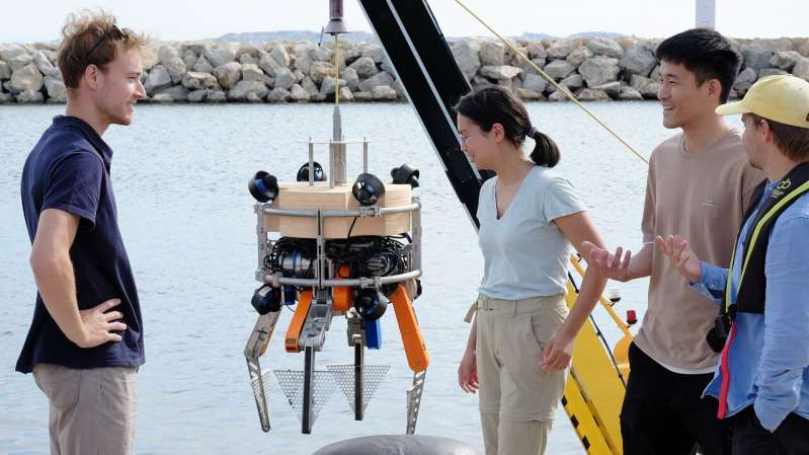 Source: Andreas Schmitz/TUM
With some marine waste ranging from e-scooters, bicycles, lost fishing nets, old tires and plastic waste, the underwater waste collection system offers a solution with its unmanned service boat and accompanying dinghy, a drone, a small underwater search robot and the TUM diving robot.
To operate, the service boat provides the underwater robots with power and data connections via cable. Additionally, the boat sends ultrasonic waves into the depths to produce a rough map of the seabed while the 50 cm long search robot scans the seabed.
Meanwhile, the TUM diving robot, which is powered by eight mini turbines, is deployed to the locations where the litter is detected and then grabs the objects and employs a winch to load the litter onto an autonomous dinghy that functions as a floating waste container.
"Since we first have to identify the rubbish and grasping objects requires a high degree of precision, we have a camera and sonar on board that enable orientation even in murky water," the researchers explained.
Once the litter is identified, the AI converts the images to 3D. This, the team explained, helps the system to decide where the object can be gripped securely.
Further, the large four-fingered hand on the autonomous gripper created by TUM for the diving robot, which has a volume of about 1 m3, can reportedly squeeze with a force of 4,000 newtons and grasp objects weighing up to roughly 250 kg. Sensors enable the gripper to determine how much force it can apply without inflicting damage, thus preventing objects such as plastic buckets from breaking or glass bottles from shattering.
The TUM robot, which weighs in at 120 kg, is enveloped by a buoyancy foam that keeps it in a suspended-like state in the water when the mini turbines are not running, thus enabling the underwater robot to move freely and maintain course.
