

Advanced sensor technologies are evolving rapidly and, as a result, are seeing an uptick in integration into industrial imaging applications such as real-time, high-throughput manufacturing and inspection systems.
These sensors transform how industrial imaging applications detect, classify and analyze materials with speed and precision previously unseen. Specifically in machine vision, there are three emerging sensor technologies for industrial imaging:
- Hyperscale imaging (HSI)
- Event-based vision (EVS)
- Terahertz imaging
According to market research firm IDTechEx, these types of sensors in machine vision distinguishes objects/materials that appear similar in the visible spectrum.
While conventional CMOS sensors are moving toward commoditization and are used ubiquitously in lower value applications, these complex emerging sensors offer much more such as detecting aspects of light beyond human vision. Other features of these emerging sensors include:
- Broader spectral range
- Larger area coverage
- Acquisition of spectral data at each pixel
- Increased temporal resolution and dynamic range
- Reduction of unwanted influence of scattering
- Global shutters at high resolution
Hyperscale imaging
In HSI, each pixel in an image contains a full spectrum, allowing for detailed chemical and material analysis. HSI captures hundreds of narrow and contiguous spectral bands across a range of the electromagnetic spectrum, which is more than conventional RGB or multispectral imaging.
When combined with AI, HSI industrial use cases include healthcare, food manufacturing and recycling.
In healthcare, the HSI-based machine vision could be used to ensure tablet coating uniformity or detect incorrect pill types or dosages.
Using HSI, machine vision could be able to detect bruises, mold, foreign objects, or ripeness of food or analyze protein/moisture/fat content of grains, nuts, meats and produce.
Finally, in recycling, HSI-based machine vision could provide accurate material identification to separate plastic polymers from other materials. Less than 5% of plastics are recycled worldwide currently.
Event-based vision
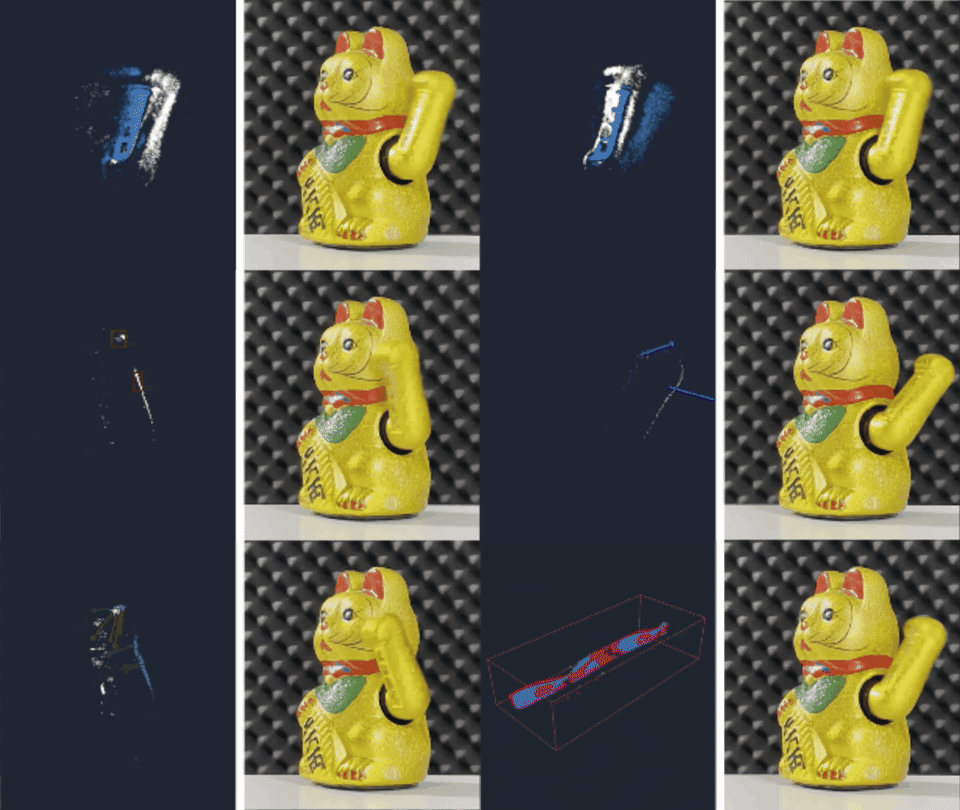 Event-based vision sensors only register movement as it changes. Anything stationary does not appear allowing users to find faults in machinery or unwanted vibrations and more. Source: IDSIndustrial imaging applications are beginning to adopt event-based vision sensors to catch fast-moving products on conveyor belts, 3D measurements on the factory floor or to obtain detailed information about objects being manufactured.
These sensors are also being integrated into robotics to dodge objects in their environment and map their surroundings. The sensors are also finding a path in maintenance where it can detect anomalies in machines or vibrations where there shouldn’t be any.
Other use cases include:
- Liquid monitoring
- Human tracking
- Visual inspections
- Scientific measurement and investigation
- Slow motion movement analysis
Event-based vision sensors are fast and can identify fast movements instantly. The temporal resolution — or the minimum measurable time difference between two consecutive pixel events — is less than 100 µs. Meaning the fastest movements can be captured with a comparable image-based frame rate of more than 10,000 FPS without motion blue. The result is no blind spots between images.
The sensors can work in bright or dark places, which makes these sensors suitable for factories with different types of lighting. EVS can produce results with nearly no light as they recognize contrast changes even from 0.08 lux.
And because the sensors ignore the environment if nothing changes, it uses less energy than other sensors and it saves space by sending only relevant data, not full images. That means not just raw data is being sent but also pixel motion is transferred with coordinates and a time stamp, allowing for results being directly available.
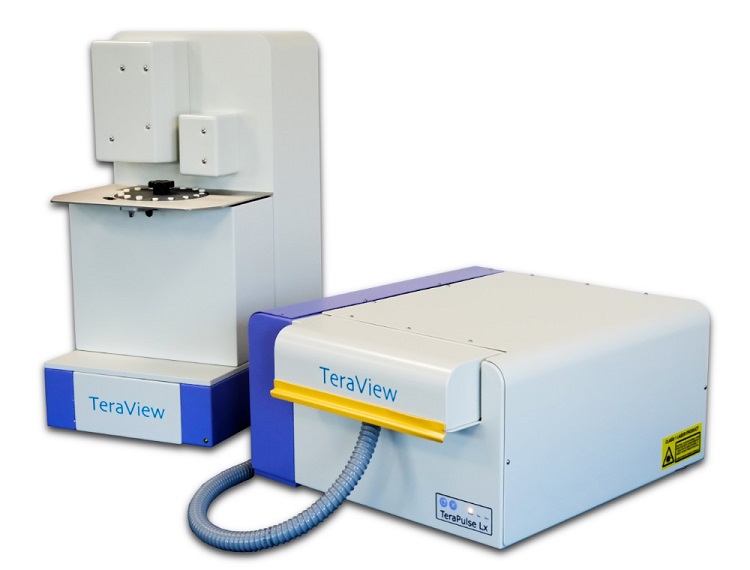 TeraView’s TeraPulse Lx system uses THz technology for imaging or spectroscopy applications for healthcare. Source: TeraView
Terahertz imaging
Perhaps the most radical of the sensor technologies is terahertz imaging (THz), which uses electromagnetic waves in the terahertz frequency range, somewhere between the microwave and infrared regions.
This non-destructive sensor technology captures information based on how the terahertz waves are absorbed, reflected or transmitted through materials. Unlike X-rays, it is non-ionizing, meaning it is safer for biological and industrial use cases.
THz measures the radiation that passes through an object to detect materials based on its absorption. It can then detect hidden layers, defects or inclusions as well as measure moisture content in industrial applications.
Use cases for THz machine vision include 3D imaging of microelectronic failures in semiconductors or inspecting multilayer packages, solder joints and ICs for defects.
In healthcare, THz machine vision has the potential to detect air bubbles in pills or used in non-evasive analysis of drug formations.
Innovations are happening in this region from the likes of TeraView, Advantest and others that are developing systems capable of thousands of frames per second.
Other innovations include portable THz cameras that can be used for field use in ruggedized environments.
Conclusion
While many of these developments are in the nascent stages, more vendors are working to integrate sensors into industrial imaging systems to enable features that are not possible with conventional CMOS or even CCD sensors. These sensors could unlock efficiency upgrades in factories, less downtime on factory floors, new ways to detect problems with food or how robots and factory machines interact with their environment.
