
Cobots, otherwise known as collaborative robots, are edging their way into industries ranging from manufacturing to healthcare and everything in between, working safely alongside humans to accomplish some, oftentimes, repetitive tasks. Yet, their growth in the food and beverage sector is, arguably, where cobots are really proving their might.
Driving the growth of cobots in the food-handling sector specifically is that cobots can take over repetitive tasks, such as product handling, case packing, palletizing and even food prep and cooking, in an industry hard hit by labor shortages.
Likewise, these collaborative robots, unlike their traditional robot counterparts that tend to be designed for isolated, automation-specific environments surrounded by safety barriers to protect against human interaction, cobots offer a smaller footprint and perform their tasks, quite literally, out in the open and alongside humans.
As such, these robots are increasingly making their debut in food-handling spaces, both large and small. Follow along with Electronics360 as it looks at some recent examples of cobots in the food-handling, prep and service space.
Grape-picking
 Source: Autopickr
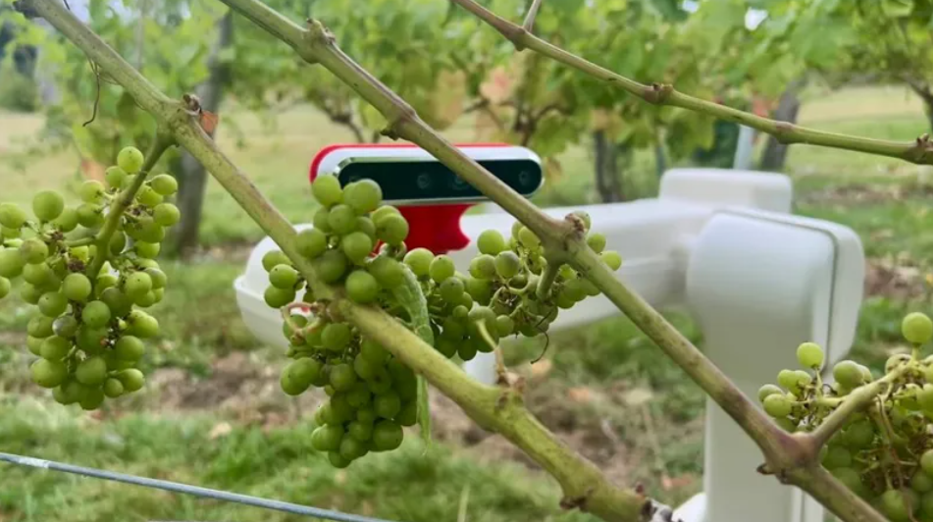
Joining a growing roster of food-handling agricultural cobots is “Vinny” the vineyard robot.
Developed by the agricultural robotics firm Autopickr, Vinny is based on a modified version of Autopickr’s automated asparagus harvester. The cobot is designed for automated hand-picking, canopy management and harvesting tasks in wine vineyards, helping vineyard managers amid labor shortages.
According to its developers, Vinny can travel up and down slopes, operating at fruit zone height, distinguishing between unripe and ripe grapes using an artificial vision system, and picking entire bunches once they are ripe.
Unlike currently available machine harvesters that tend to agitate vines to extract grapes, Vinny is capable of picking intact bunches much like humans who pick whole bunches by hand, which wine producers tend to prefer.
Potato-peeling
Another food-handling cobot has been developed by a team of researchers from Massachusetts Institute of Technology (MIT) that can peel vegetables as well as perform an assortment of other kitchen tasks.
According to its developers, the dexterous manipulation system, which features an Allegro hand mounted on a Franka robot arm, uses its finger to rotate fruits and vegetables while another Franka robot arm uses its gripper to grasp a peeler for peeling.
To accomplish this, the MIT researchers focused on constrained dexterous manipulation for food peeling, which is a task that presents an assortment of constraints on the reorientation controller, including the requirement for the hand to securely hold the object following reorientation for peeling.
To mimic how humans peel potatoes, for instance, the system was taught to grasp the potato in one hand and use the second hand to actuate a peeler to remove the potato’s skin. Once the first side of the potato is peeled, it is rotated while being held in the hand and subsequently peeled again and the sequence of rotating and peeling continues until all of the potato’s skin is removed.
The researchers added that the robotic system can re-orient different vegetables using the Allegro hand so that the skin can be peeled using another manipulator. Further, the reorientation controller for the Allegro hand is taught via reinforcement learning, while the peeling is conducted via teleoperation.
Grocery-bagging
MIT has also developed a cobot capable of autonomously bagging groceries.
The so-called RoboGrocery reportedly combines computer vision with a soft robotic gripper capable of bagging a range of objects. To demonstrate RoboGrocery’s capabilities, the researchers placed 10 objects previously unknown to the robot on a grocery-store-like conveyer belt.
With products ranging from grapes, bread, kale, muffins and crackers to soup cans, meal boxes and ice cream containers, the RoboGrocery’s vision system activated first, enabling it to detect the objects before determining their size and orientation on the belt.
Once RoboGrocery’s grasper touched the grapes, its developers reported that pressure sensors in the robot's fingers determined that the product is delicate and should thus not go to the bottom of the bag, while the more rigid soup can was subsequently placed at the bottom of the bag.
Food-manufacturing
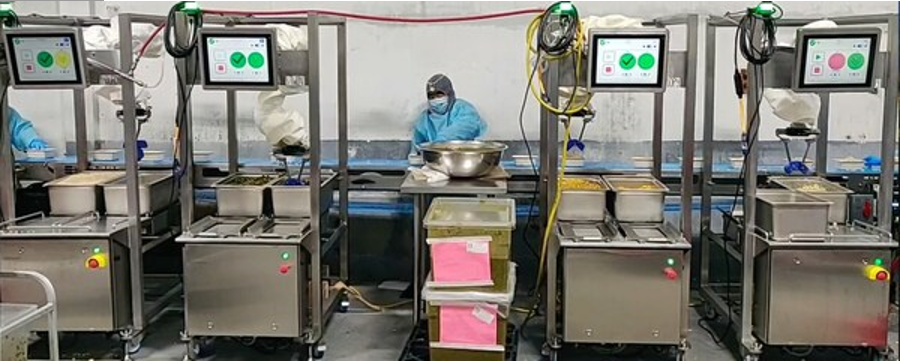
AI-driven food robotics solution company Chef Robotics has launched an AI-powered flexible food cobot designed to help food manufacturers overcome the global food labor shortage and increase production volume.
 Source: Chef Robots
According to its developers, the cobot operates using Chef Robotic's proprietary food manipulation software, ChefOS, to partially automate food production. This reportedly enables Chef engineers to train ChefOS on real-world data accumulated from cobots deployed at customer production sites.
With each meal the cobots assemble in production facilities, Chef's core AI models for food manipulation improve, and, over time, the system better adapts to variances in food and ingredients, of any portion size, in any container.
The company envisions that the cobot system will eventually makes its way into every commercial kitchen in the country.
Breakfast-making
A cobot from the China-based robotics firm Dobot, is now autonomously preparing breakfast. The system, dubbed Atom, stands five feet tall and weighs 136 pounds.
Designed to function in real-world settings, Atom is expected to make its way into consumer’s homes where it can cook meals.
Specifically, Atom doesn’t just cook; the cobot manipulates fruit, precisely pours liquids and prepares nutritious, elaborate breakfasts.
Food-prepping and food-serving
A popular Chinese restaurant is operated by an autonomous robotic system capable of both food preparation and food service.
The Beijing restaurant in the Haidilao chain of restaurants, which specializes in Szechuan-style hot pot cuisine where raw meat and vegetables are cooked in a pot of flavored soup, no longer relies entirely on humans for food prep tasks in the kitchen.
Rather, robotic arms developed in collaboration with tech giant Panasonic carry out those tasks by gathering and preparing ingredients and individualized dishes according to customer requests. While food prep takes place in the AI-driven kitchen, customers can view the robotic arms in action from their tables via large screens situated throughout the restaurant. Once completed, the food is ushered to waiting patrons by any one of six robots.
These are just a handful of examples of robots transforming the food-handling, prepping and service sector. Check back with Electronics360 for more on this developing technology.
