
Driven by demands that include high-capacity transmission of 4K/8K HD video and high-speed communications between AI-based IoT devices, the electronics world has begun to see the emergence of designs based on the latest version of the Universal Serial Bus (USB) standard, USB4 Version 2.0. At 80 Gbit/s, the data transfer speed of USB4 v2 is twice that of USB4 v1, and it allows efficient high-speed video transfer to a display or storage drive via a USB Type-C cable.
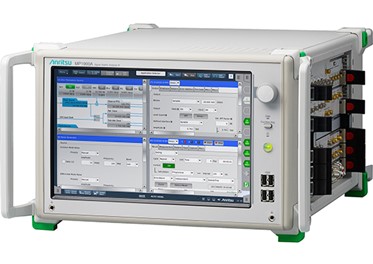 New enhancements to the MP100A, above, enable support for the latest version of USB4 v2, a standard for data transfer at 80 Gbit/s speed. Source: Anritsu Company True to form, Anritsu Company is keeping pace with this development through enhancements to its Signal Quality Analyzer-R MP1900A. New functionality enables the MP1900A to address the higher Baud rate and PAM3 modulation associated with USB4v2. The device can now produce a high-quality signal to conduct accurate high-frequency noise and jitter analysis to evaluate USB4v2 receivers and ensure they are compliant with the USB device data transmission standard.
According to Anritsu, reliable receiver testing is assured due to the low jitter and high-quality waveform performance of the PAM3 signal outputted by the MP1900A’s built-in pulse pattern generator (PPG). The PPG module allows the analyzer to simulate and evaluate poor communication quality conditions by adding noise and jitter to high-quality signals. It also supports the Receiver Frequency Variation Training Test added to the USB4 v2 compliance test specification to evaluate the training function to establish stable communication conditions during USB connection.
This new support for USB4 v2 expands the existing analysis capability of the MP1900A. An eight-slot modular, high-performance bit error ratio tester (BERT), the device was initially developed to address the transition of data-center network interfaces to faster 200 GbE/400 GbE/800 GbE standards, the adoption of the PCI Express Gen6 standard to support communications-equipment interconnect speeds of 64 GT/s and the deployment of multichannel technologies. The MP1900A supports receiver testing of a variety of major high-speed computing and data communications interfaces including legacy USB, PCIe, Thunderbolt and 400 GbE/800 GbE. The existing MP1900A, which supports USB 3.2 and USB4 v1 receiver tests, can be upgraded to USB4 v2 by adding the new option and PPG module.
