
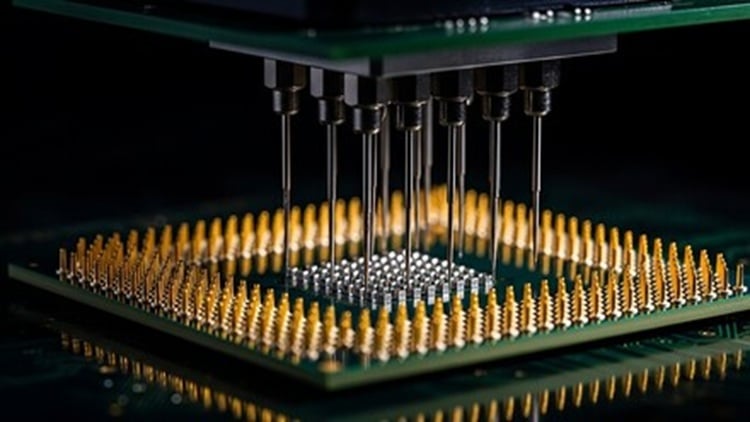
In-circuit testing (ICT) is a manufacturing test method used on assembled printed circuit boards (PCBs). Instead of assessing whether the entire board performs its final function, ICT focuses on checking whether the individual components and connections on the PCB are correctly assembled and electrically healthy. ICT typically uses a “bed-of-nails” fixture, where many probes touch test points on the PCB. These probes electrically access different nets and components on the board. The system then stimulates and measures each component separately using guarding and voltage forcing techniques so nearby components do not interfere with the measurement.
Why ICT became important
Functional testing was the norm until ICT gained traction in the late 1970s. However, engineers had to fully understand the board's operation before they could validate its outputs, which made functional tests tedious and time-consuming.
ICT transformed the philosophy of testing. Manufacturers could check each component's placement, electrical connections and operation to requirements without having to wait to see if the entire board worked. Earlier and more precise fault detection greatly enhanced manufacturing efficiency. For high-volume PCB manufacture, ICT became the primary testing approach very fast.
ICT has several strengths:
- Simple and fast test generation
- High fault coverage
- Fast throughput for production lines
- Excellent fault diagnostics and repair information
It can detect problems such as:
- Shorts and opens
- Missing components
- Wrong analog values
- Faulty digital logic
- Open pins on ICs and connectors
- Memory- and boundary-scan-related faults
Challenges facing modern ICT
Modern PCBs are now much smaller, denser and more complex than previously. The electrical components have tiny pins, high pin counts, low operating voltages and limited physical access points. As PCB density increased, traditional test probes could no longer easily reach all signals on the board. Therefore, manufacturers developed fine-point probing, micro-access technologies, boundary scan techniques, vectorless testing and indirect testing methods to maintain fault coverage even when physical access becomes limited. These new probing methods allowed testing of very small PCB traces and modern packages like ball grid arrays (BGAs).
What is functional testing?
Functional testing is a more application-oriented test method. Instead of checking individual components separately, functional testing powers up the board and verifies whether the complete circuit behaves correctly as a finished product. For example, functional testing may verify whether a communication board transmits data properly and whether system-level functions work under real operating conditions. Unlike ICT, functional testing evaluates the board as an integrated system rather than as isolated components.
Differences between ICT and functional testing
ICT focuses on manufacturing defects
ICT is mainly designed to catch assembly-related issues such as soldering defects, wrong or missing components, short circuits, open connections and pin-level electrical faults. It provides very precise diagnostics because it knows exactly which component or pin failed.
Functional testing focuses on system behavior
Functional testing checks whether the entire product performs its intended task under powered operating conditions. It validates real-world operation rather than only assembly integrity. However, functional testing alone can be slower, more complex to develop and harder to diagnose when failures occur because a system-level failure may originate from many possible causes.
Integration of ICT and functional testing
It is worth mentioning that modern ICT systems are no longer limited to pure in-circuit testing. They increasingly integrate functional test capabilities into the same platform. Some ICT systems now include PXI instrumentation and additional functional modules that allow functional measurements, analog functional verification, boundary scan operations and system-level electrical testing within a single test station.
The benefits of this integration include a reduced number of test stages, faster production cycle time, lower equipment costs, improved fault coverage, earlier defect detection and the need for fewer operators. Instead of sending boards through separate ICT and functional test stations, manufacturers can combine multiple testing approaches into one integrated system.
Boundary scan and built-in self-test
Modern boards increasingly contain built-in testing capabilities such as boundary scan (BSCAN), embedded instrumentation, processor-controlled self-tests and built-in self-test (BIST) features. Modern ICT systems can interact with these embedded features to improve coverage on difficult-to-access boards.
This is essentially a move toward a broader concept of "Electrical Test Controllers" rather than traditional ICT machines. These systems now combine ICT, functional testing, BSCAN, cluster testing, PLD programming and embedded self-tests into one unified manufacturing platform.
Conclusion
ICT has progressed considerably beyond its initial function. As far as modern ICT systems are concerned, they are more than just "bed-of-nails" testers. Their evolution into sophisticated electrical test platforms has allowed them to incorporate features such as low-voltage digital testing, embedded self-test technologies, BSCAN, functional verification and testing at the component level. These days, systems are more accurately referred to as "Electrical Test Controllers" since they integrate many testing theories into a single adaptable production solution.
