
Used in robot navigation, object detection and elsewhere, time of flight (ToF) is a principle used to gauge the distance of a target by emitting photons and measuring the time it takes for them to be reflected back to a sensor.
For semiconductor technology manufacturer ST Microelectronics, ToF technology is trademarked as FlightSense — and the goal of the company’s newest FlightSense multi-zone distance sensor is to bring lifelike situational awareness to applications like home automation, domestic appliances, computers, robots and smart equipment.
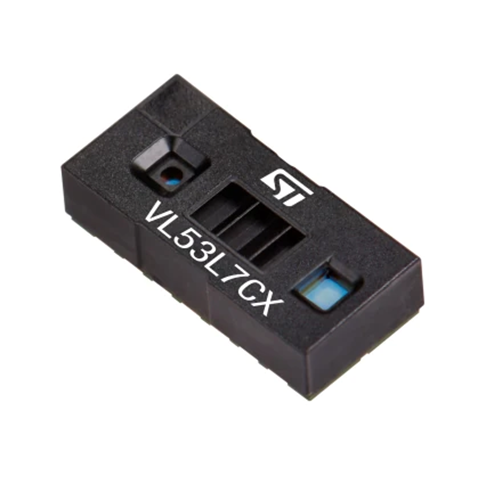 The new VL53L7CX offers a 90° diagonal field of view. Source: STMircoelectronics.That may sound a little like something out of a science-fiction nightmare, but — unlike camera sensors that are sometimes positioned for these tasks — ST’s VL53L7CX does not capture images, thus ensuring user privacy. Yet the new device brings a camera-like field of view to the job, with what ST says is an unprecedented 90° diagonal for enhanced peripheral sensing. This translates to better performance of presence detection and system activation, such as activating a screen or waking an appliance like an oven or coffee machine.
Capabilities include 3D scene mapping and simultaneous measurement of distance to multiple objects in multiple zones, opening the sensor to applications such as people detection and tracking, over-shoulder warning, occupancy detection, and storage/parking management. It can also improve floor sensing, cliff prediction, obstacle avoidance, and small-object detection for robots, or track full and empty bins for enhanced smart waste management. Additional applications include keystone correction in projectors and extended hand tracking for gesture recognition using the STGesture software pack.
A look at the VL53L7CX data sheet reveals some notable specs, including native 64-zone (8 x 8) sensing and measurement of distance to multiple objects in each zone, up to 350 cm. ST-patented histogram algorithms allow multi-target detection and measurement within the field of view, as well as smudge immunity above 60 cm. Linearity is consistent when measuring distance to objects as close as 2 cm.
The sensor consumes just 5.4 mW in low-power mode, and it can operate in an autonomous mode that allows the host system to power down and wake only when a threshold value is reached. Thresholds include distance to nearest object, signal rate and detection of motion. The new sensor is pin-to-pin and driver compatible with the previous-generation device, VL53L5CX.
For more on ToF sensing, ST Microelectronics offers a webinar that discusses use cases and resources to assist hardware and software development.
