
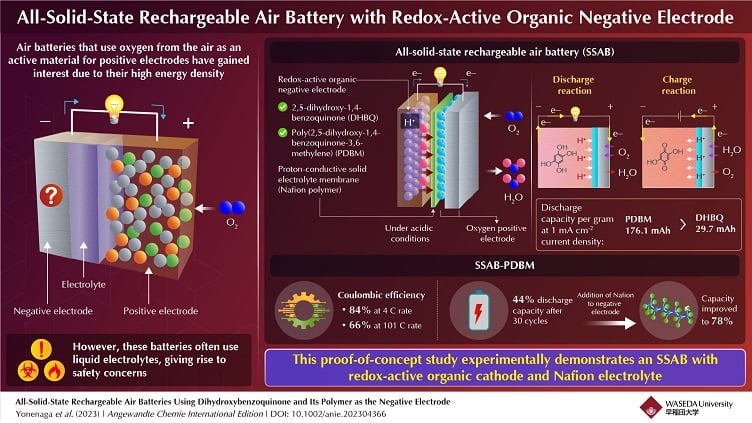
Researchers from Waseda University in Japan have developed a so-called solid-state rechargeable air battery (SSAB) and found it can potentially extend the battery life of smart devices.
Unlike lithium-ion batteries, which use liquid electrolytes, solid-state batteries use solid electrodes and solid electrolytes. The idea is that these solid-state batteries overcome many of the standard problems with liquid-based batteries, including:
- Flammability
- Limited voltage
- Unstable reactants
- Poor long-term cyclability and strength
The SSAB is composed of a redox-active organic negative electrode and a proton-conductive polymer electrolyte. Redox-active organic modules — such as quinone- and amine-based molecules — have been used as negative electrodes in rechargeable metal air batteries with oxygen-reducing positive electrodes. These batteries have a high performance but because they use liquid electrolytes it still poses safety concerns like high electrical resistance, leaching effects and flammability.
(Learn more about rechargeable batteries on Globalspec.com)
The air battery
Unlike the metal air batteries, researchers chose 2,5-dihydroxy-1,4-benzoquinone (DHBQ) and its polymer poly (2,5-dihydroxy-1,4-benzoquinone-3,6-methylene) (PDBM) as active materials for the negative electrode. They also used a proton-conductive polymer called Nafion as the solid electrolyte, replacing conventional liquid electrolytes.
“To the best of my knowledge, no air batteries based on organic electrodes and solid polymer electrolyte have been developed yet,” said Kenji Miyatake, a professor from Waseda University.
During experiments, researchers found that unlike typical air batteries that use a metallic negative electrode and organic liquid electrolyte, the SSAB did not deteriorate in the presence of water and oxygen. Additionally, replacing the redox-active molecule DHBQ with its polymeric counterpart PDBM formed a better negative electrode.
The results were significant and confirmed that the addition of Nafion improved the performance and durability of the PDPM-based electrode.
“This technology can extend the battery life of small electronic gadgets such as smartphones and eventually contribute to realizing a carbon-free society,” Miyatake said.
The full research can be found in the journal Angewandt Chemie.
