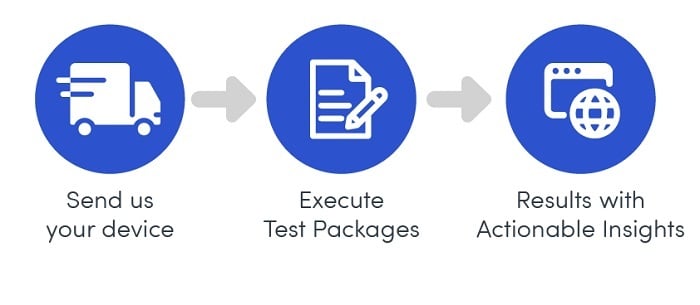
A new “Send Us Your Device” test as a service option is now available from Spirent Communications for Wi-Fi customers. The first of its kind from a manufacturer of advanced Wi-Fi testbeds, the service allows access to the advanced capabilities of Spirent’s OCTOBOX emulation and testing solution to organizations where the capital expenditure and considerable expertise required to own and manage such complex test setups may not be an option.
The growing complexity of Wi-Fi technology is requiring developers and manufacturers to rethink their approach to performance testing for new Wi-Fi enabled devices. The progression of Wi-Fi 6 and 6E, growth of mesh multi-point access networks, and expectations around 5G and Wi-Fi convergence are creating new application and business models that require fresh approaches to testing.
The new service is targeted at companies with Wi-Fi testing needs but little or no onsite test facilities of their own, as well as organizations like chipset developers, internet of things and consumer device makers, and network equipment manufacturers that need to perform regular Wi-Fi testing but may not have the in-house expertise to create, deploy and efficiently execute the range of performance tests the industry now requires. It is anticipated that Spirent OCTOBOX owners and others with existing labs will also find the service beneficial when they experience occasional bandwidth overflow at their own testing facility.
 Source: Spirent Communications
Available to customers globally, the service is based at Spirent’s Massachusetts research facility where OCTOBOX testbeds are developed and manufactured. This allows Spirent to easily scale up and down testing services for customers based on their ever-changing needs and leverage the company’s unrivalled Wi-Fi emulation and testing expertise. The Spirent lab also provides test environments that are engineered with optimized hardware to ensure all devices are validated against the highest quality standards accepted for deployment by carriers and enterprises, such as TR-398 and RFC 2544.
