
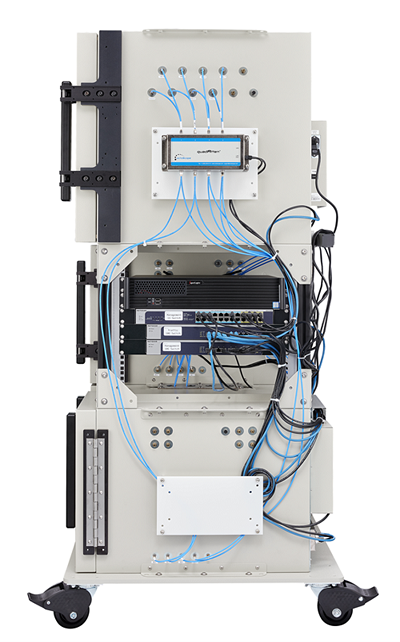
 The OctoScope STACK-MID is the company’s newest personal testbed. Source: OctoScope Inc.Electronics360 reported recently on using testbeds made by U.S.-based company OctoScope to run test cases conforming to the latest Broadband Forum standard for home router performance. The company, which was acquired by British telecommunications testing company Spirent earlier this year, has just announced the release of a new testbed with a focus on home Wi-Fi devices, the STACK-MID.
Like its smaller cousin STACK-MIN, the new testbed is a subset of OctoScope’s fully featured STACK-MAX. It enables communications services providers (CSPs) to test Wi-Fi solutions spanning a range of recent technologies, including Wi-Fi 6, Wi-Fi 6E, MU-MIMO and OFDMA. It can also be combined with OctoScope’s Tracker field-to-lab replay solution for the optimization of mesh networks — realistic deployment scenarios can be recorded in the field and replicated inside the testbed. Testing and optimization possibilities include roaming, access point steering, band steering and load balancing.
“Our CSP customers tell us that a significant proportion of service calls from their customers are Wi-Fi related, as home Wi-Fi solutions become ever more sophisticated,” said Fanny Mlinarsky, founder of OctoScope and senior vice president of Wi-Fi products at Spirent. “CSPs are looking for testing solutions to assess and improve performance of Wi-Fi routers, gateways and networks, especially in the face of new Wi-Fi technologies and network topologies such as mesh being increasingly adopted in the home.… With STACK-MID, service providers can be confident that devices under test will perform as they should when deployed in the field.”
The company’s isolated, repeatable and automated wireless personal testbeds are configurable for automated regression test sequences with a range of airlink conditions and interference scenarios, as well as scalable to support a single device under test (DUT) or multi-node mesh systems under test. Stackable and completely isolated from external interference, the testbeds can be used at an engineer’s office or lab bench.
Each testbed is controlled by a dedicated Node.js web server, which provides the time base and controls the built-in instruments, DUT configuration, traffic and test flow. The server is accessible via a browser UI for manual control, or via REST API for test automation.
Test results are saved in a MongoDB database, enabling multiple teams to collaborate by sharing the test automation scripts and test results.
