
In the race to reduce aircraft emissions, developers increasingly are moving toward more efficient designs including electrical systems that replace today’s pneumatics and hydraulics powering everything from on-board alternators to actuators and auxiliary power units (APUs). To enable next-generation aircraft electrical systems, new power conversion technology is required. Microchip Technology Inc. has announced its development with Clean Sky, a joint European Commission (EC) and industry consortium, of the first aerospace-qualified baseless power modules enabling higher-efficiency, lighter and more compact power conversion and motor drive systems.
Partnering with Clean Sky to support aerospace industry goals set by the EC for stricter emission standards that result in climate neutral aviation by 2050, Microchip’s BL1, BL2 and BL3 family of baseless power modules provide greater efficiency in AC-to-DC and DC-to-AC power conversion and generation through the integration of its silicon carbide power semiconductor technology. The innovative design is 40% lighter 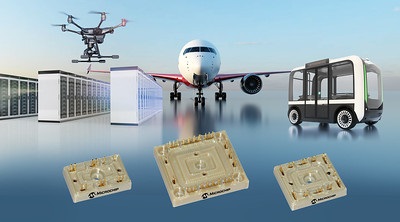 Source: Microchip Technology Inc.than other devices due to the modified substrate and also produces an approximate 10% cost savings over standard power modules that incorporate metal baseplates. Microchip’s BL1, BL2, and BL3 devices meet all mechanical and environmental compliance guidelines set forth in RTCA DO-160G, the “Environmental Conditions and Test Procedures for Airborne Equipment,” Version G (August 2010). RTCA is the industry consortium that develops consensus on critical aviation modernization issues.
The modules are available in low-profile, low-inductance packaging with power and signal connectors that designers can solder directly on printed circuit boards, helping to speed development and increase reliability. And, the same height between the modules in the family enables them to be paralleled or connected in a three-phase bridge and other topologies to achieve higher-performing power converters and inverters.
The family incorporates silicon carbide metal oxide-semiconductor field-effect transistors (MOSFETs) and Schottky barrier diodes to maximize system efficiency. In packages delivering 100 W to more than 10 KW of power, the BL1, BL2 and BL3 family is available in numerous topology options including phase leg, full bridge, asymmetric bridge, boost, buck and dual common source. These high-reliability power modules are available in voltage ranges from 600 V to 1,200 V in silicon carbide MOSFETs and insulated-gate bipolar transistors to 1,600 V for rectifier diodes.
