
The impending IPO of SpaceX is bound to be one of the largest public offerings in history.
While that will likely generate plenty of funds for the aerospace company and its investors, according to data from TrendForce, it will create a gold rush for those electronic and system component vendors used in satellite communication (SATCOM), direct-to-cell (DTC) connectivity and AI computing.
TrendForce said the global space economy is entering a phase of growth as satellite networks, AI infrastructure and space applications are integrating together. The worldwide satellite industry is forecast to generate $447 billion by 2027, managing an annual growth rate of 14%.
SpaceX is one of the main companies enabling satellite broadband through its Starlink technology but is aggressively pursuing other SATCOM technologies like DTC, AI space computing and space-based solar power (SBSP).
SpaceX recently signed a partnership with Deutsche Telekom that will allow users to automatically switch to Starlink’s SATCOM services when smartphones lose terrestrial service. In the U.S., Starlink launched a promotional bundle with U.S. mobile in April of 2026 for SATCOM coverage.
Meanwhile, SpaceX and Tesla are building the so-called Terafab in the U.S. and Intel Corp. is set to help build it with its foundry technologies. Terafab is designed to produce chips for Tesla vehicles and robots, SpaceX aerospace endeavors and data centers for xAI. Intel will help the companies with refactor silicon technology.
Making moves
In September of 2025, SpaceX acquired EchoStar’s AWS-3, AWS-4 and H-Block spectrum licenses for about $17 billion. The move is designed to develop and deploy Starlink’s next generation DTC technology complete with 5G protocols.
Additionally, SpaceX is enhancing its AI space computing by analyzing agricultural monitoring, maritime tracking and environmental surveillance images directly in orbit. It will then transmit the processed results to its ground networks to reduce requirements of data transmission and AI processing load of data centers, TrendForce said.
SpaceX is also building up its LEO system to span terrestrial and orbital infrastructure by integrating:
- SATCOM
- Reusable rockets
- AI computing platforms
TrendForce said this will help to strengthen SpaceX’s position in the SATCOM and space computing markets, which is gaining traction to develop next-generation semiconductors using in-orbit manufacturing.
But it will likely also be a boon for companies supplying components to SpaceX for these endeavors.
Component boom
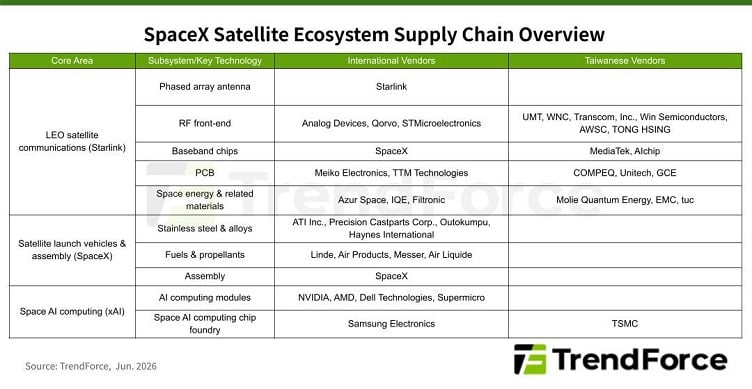
SpaceX’s Starlink supply chain includes components like satellite antenna modules, RF front-end modules, PCBs and beamforming ICs.
SpaceX has been developing its own beamforming ICs internally but ST Microelectronics supplies Starlink with antenna RF chips and Azur Space provides it with solar cells for Starshield. IQR and Filtronic, meanwhile, supply the company with compound semiconductors like gallium arsenide (GaAs) and gallium nitride (GaN).
TrendForce said this combination of internally grown chips and international supply chain partnerships will help improve its SATCOM performance and deployment scale while also driving demand for advanced semiconductors and aerospace components.
Space computing and rockets
Currently, ATI and Precision Castparts are providing alloys and cast components for use in Raptor engine and Starship platforms for SpaceX, according to TrendForce. While industrial gas providers Linde and Air Products send cryogenic gases like liquid oxygen and liquid nitrogen for rocket testing, launch operations and ground infrastructure.
In terms of AI space computing, Nvidia has introduced its Space-1 Vera Rubin in-orbit AI computing platform and AMD is expanding its radiation hardened field programmable gate arrays (FPGAs) through its Xilinx brand and high-performance computing solutions such as the Kintex UltraScale XQR FPGAs for future autonomous satellite requirements.
Taiwanese vendors enter the fray
But there will likely be several competitors across these sectors rise to compete for SpaceX’s supply chain most likely from Taiwan.
Among these includes UMT for high-frequency microwave components and filters; COMPEQ’s expansion for in-orbit AI computing and high-end HDI boards; WNC’s antenna design and RF system capabilities; TSEC Corp and Molie Quantum Energy’s solar cells and lithium batteries; and EMC and ITEQ’s high-end copper clad laminate.
TrendForce said as SATCOM and AI computing continue converging, these Taiwanese supplies will likely play an important role in SpaceX’s supply chain as well as the overall space industry.
