
Printed electronics hold promise because of the low cost of manufacturing, an attractive and flexible form factor, ease of production and integration as well as unlocking new device possibilities. But to get there, the printed electronics process needs high conductivity and stability to reach its potential. As such, researchers from Linköping University of Sweden have developed a high-conductivity polymer ink that could allow for printed electronics with high energy efficiency.
Similar electrically conducting polymers have created flexible and lightweight electronic components such as organic biosensors, solar cells, light emitting diodes (LEDs), transistors and batteries.
The polymers can be tuned using a method known as doping where various dopant molecules are added to the polymer to change its properties. Depending on the dopant, the polymer can conduct electricity by the motion of either negatively charged electrons or positively charged holes. Linköping University’s ink polymer is a conductive n-type polymer ink, stable in air and at high temperatures.
"This is a major advance that makes the next generation of printed electronic devices possible,” said Simone Fabiano, senior lecturer in the Department of Science and Technology at Linköping University. “The lack of a suitable n-type polymer has been like walking on one leg when designing functional electronic devices. We can now provide the second leg.”
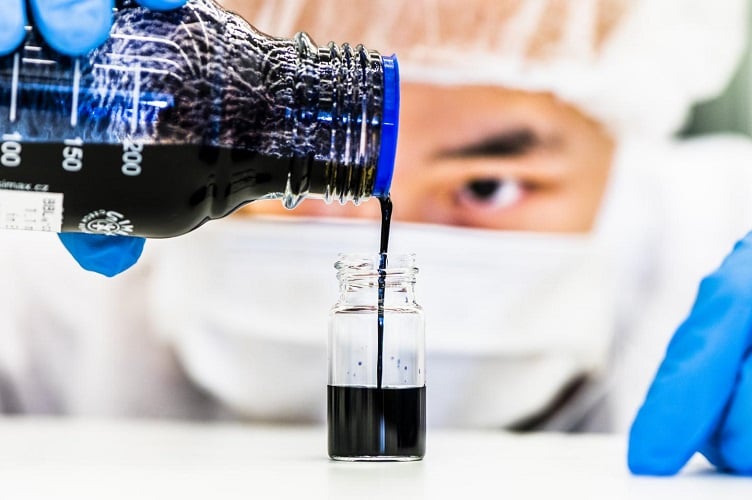
The n-type material is a form of ink with ethanol as the solvent. It is deposited by spraying the solution onto a surface, making organic electronic devices easier and cheaper to manufacture, Linköping University said. It is also more eco-friendly than other n-type organic conductors under development that contain harmful solvent. The polymer formulation is known as BBL:PEI.
"Large-scale production is already feasible, and we are thrilled to have come so far in a relatively short time,” Simone Fabiano said. “We expect BBL:PEI to have the same impact as PEDOT:PSS. At the same time, much remains to be done to adapt the ink to various technologies, and we need to learn more about the material.”
