
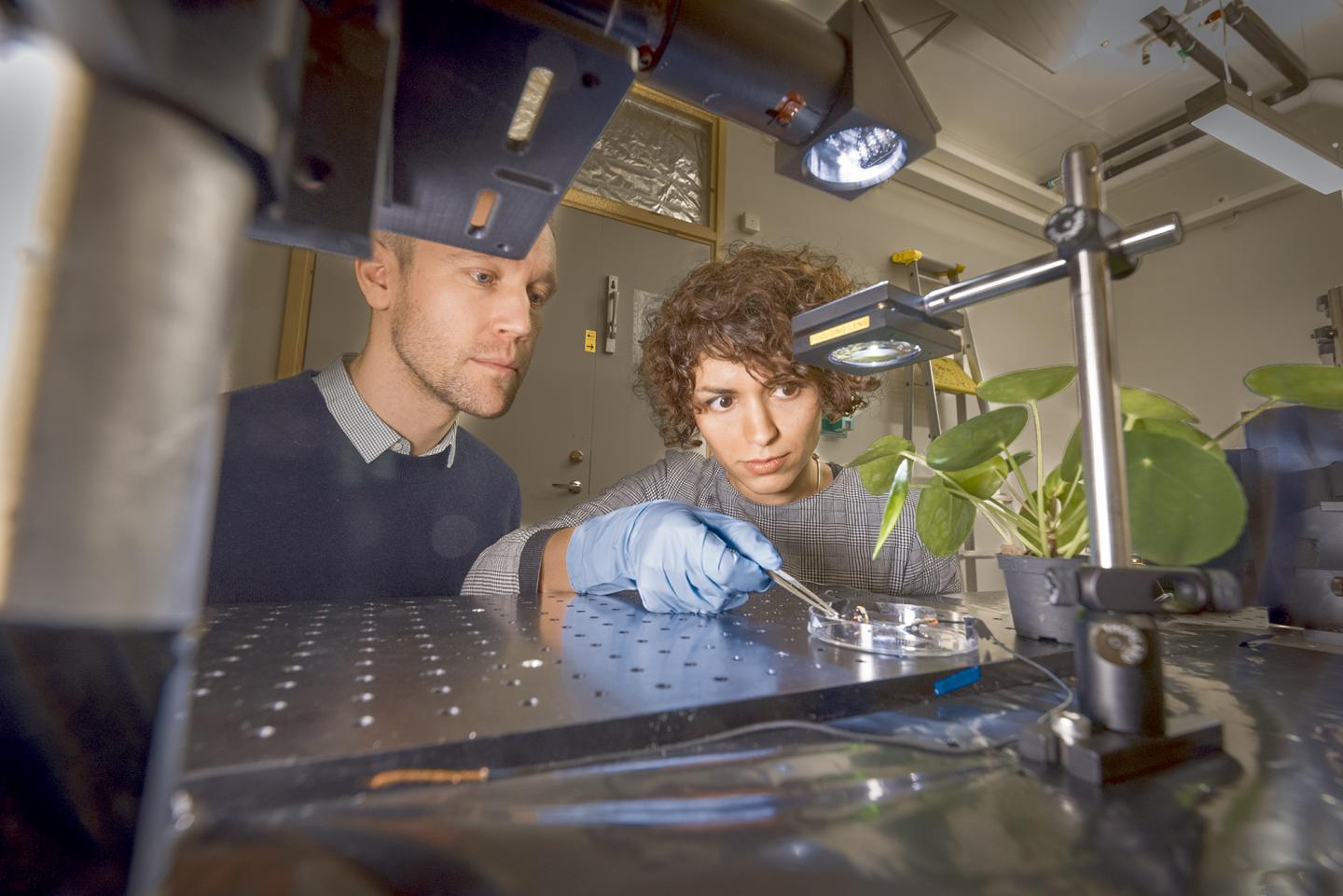
 This is Magnus Jonsson and Mina Shiran Chaharsoughi at the Laboratory of Organic Electronics, Linköping University. Source: Thor Balkhed
Leaves fluttering in the wind are one of my favorite parts of fall. But now flowing leaves are more than just a pretty thing to look at. Researchers from the Laboratory of Organic Electronics at Linköping University have created a method that uses flowing leaves to create electricity. This method uses the fluctuating light from sunshine to shade to create an electrical impulse.
"Plants and their photosynthesis systems are continuously subjected to fluctuations between sunshine and shade. We have drawn inspiration from this and developed a combination of materials in which changes in heating between sunshine and shade generate electricity," said Magnus Jonsson, docent and principal investigator for the research group in organic photonics and nano-optics at the Laboratory of Organic Electronics, Linköping University.
The Linköping team has previously worked with researchers from the University of Gothenburg to create a small nanoantenna that has the ability to absorb sunlight and generate heat. These antennas react to near-infrared light and they could be placed in window glass and they would reduce cold and save energy.
These nanoantennas have combined with pyroelectric film and been further developed to create a tiny optical generator. Pyroelectric materials develop an electrical voltage when the material temperature changes. The temperature change causes a charge to move generated and electric current in the circuit.
The antennas are made out of small gold nanodiscs whose diameter measures at 160 nm. The discs are put on a substrate and then coated with a polymeric film that created the pyroelectric properties.
"The nanoantennas can be manufactured across large areas, with billions of the small discs uniformly distributed over the surface. The spacing between discs in our case is approximately 0.3 micrometers. We have used gold and silver, but they can also be manufactured from aluminum or copper," said Jonsson.
The antennas generate heat and the heat is then converted to electricity with the polymer. The polymer film has to be polarized so a dipole is created across it, guaranteeing that there is a distinct difference between positive and negative charges. The polarization affects how much power is actually generated and the thickness of the film has been proved to not have an effect.
"We force the polarisation into the material, and it remains polarised for a long time," said team member Mina Shiran Chaharsoughi.
Chaharsoughi tested the effect by holding a twig with leaves in the airflow of a fan. The leaves’ motion created sunshine and shade on the optical generator. This produced small electrical currents that were strong enough to power an external circuit.
"The research is at an early stage, but we may in the future be able to use the natural fluctuations between sunshine and shade in trees to harvest energy," said Jonsson.
The paper on this research was published in Advanced Optical Materials.
