
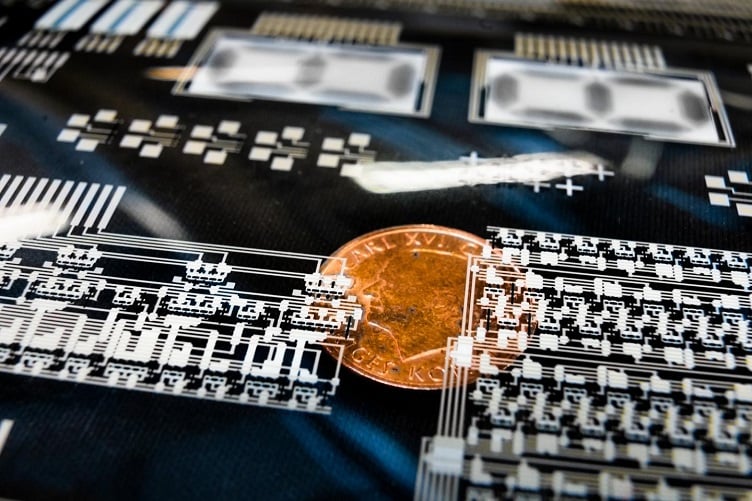
Researchers have developed a new way to print integrated circuits (ICs) using screen printing in only a few processing steps.
The team, comprised of researchers from Linköping University and RISE, Campus Norrköping, were able to print complete ICs with more than 100 organic electrochemical transistors with a line width of about 100 micrometers.
The key is ensuring that different layers end up in exactly the right place and the screen printing frames can mesh so that they can print extremely fine lines. Researchers said that they have spent many years working to develop the right printing ink with the right properties to enable this method of printing ICs.
"One of the major advances is that we have been able to use printed circuits to create an interface with traditional silicon-based electronic components,” said Magnus Berggren, professor of organic electronics and director of Linköping University's Laboratory of Organic Electronics (LOE). “We have developed several types of printed circuits based on organic electrochemical transistors. One of these is a shift-register, which can form an interface and deal with the contact between the silicon-based circuit and other electronic components such as sensors and displays. This means that we can now use a silicon chip with fewer contacts, which needs a smaller area and is in this way cheaper.”
The team addressed a number of challenges, including reducing circuit size, increasing the quality of the transistors and solving integration with the silicon-based circuits needed to process signals and communicate with its surroundings. They also developed the ink to print the thin lines and improve screen printing frames in the miniaturization process.
With these developments in place, researchers can place more than 1,000 organic electrochemical transistors on an A4-sized plastic substrate and connect them in different ways to create different types of printed ICs. These could go on to power an electrochromic display or another part of the internet of things (IoT).
