
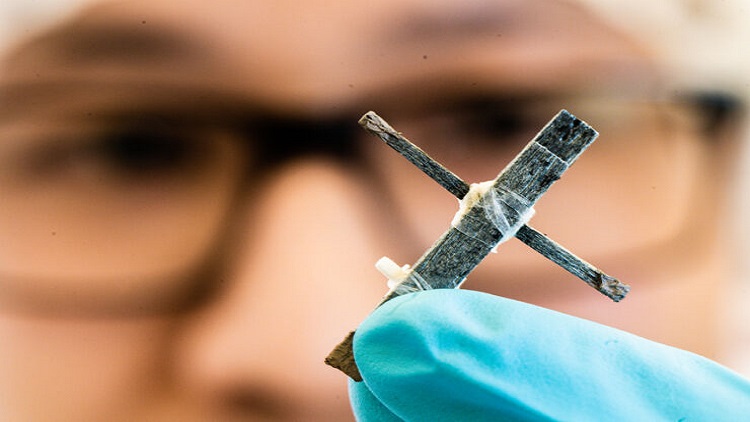
Researchers in Sweden have gone out on a limb and engineered the world’s first wooden electrical transistor. While the devices are bulky, they can function continuously and regulate electricity flow without deteriorating, possibly paving the way toward more sustainable electronics.
The proof of principle transistor is 3 cm across and switches at less than 1 Hz. Balsa wood was selected as the technology involved requires a grain-less wood that is evenly structured throughout. The channels remaining after removal of lignin were filled with the conductive polymer poly(3,4-ethylenedioxythiophene)-polystyrene sulfonate (PEDOT:PSS) to form an electrically conductive wood material.
Three pieces of conducting wood were arranged in a T shape, the top of which served as the transistor channel, with a source on one end and a drain on the other. The channel was sandwiched between two gate pieces, forming the leg of the T, and a gel electrolyte was layered at the points of contact between the channel and the gates. A voltage applied to the gates delivers hydrogen ions from the electrolyte into the polymer, causing a chemical reaction that changes the conductivity of the PEDOT:PSS. This reaction is reversible, allowing for the on-off operation of the wood-based transistor.
The wood transistor based on this material was demonstrated to have an electrical conductivity of up to 69 Siemens/meter and to switch power on and off with somewhat of a delay: switching it off took about a second; on, about five seconds. The biodegradable device engineered by researchers from Linköping University and KTH Royal Institute of Technology may find use as an on/off switch for solar cells, batteries, or sensors that may be incorporated into wood.
The research is published in the Proceedings of the National Academy of Sciences.
