
Manufacturers incur a high cost when machines fail and have to be taken out of operation. Fraunhofer Institute for Machine Tools and Forming Technology (Fraunhofer IWU) launched the Presswerk 4.0 research project to tackle this issue as it relates specifically to press shops.
By employing targeted data networking in manufacturing, the researchers intend to help employees recognize and correct failures sooner, so failure-related downtime is reduced by at least half.
Press shops receive steel sheets in huge rolls that are cut to the required size. The sheets pass through multiple presses to be stamped into the shape of a car door, for example. If a crack is discovered, the component must be rejected. If the fault affects all the components coming through that press, the press must stop so workers can troubleshoot the problem. The issue could be with the raw material, the lubrication, a faulty tool or the press itself. Determining this and getting the machine back online takes 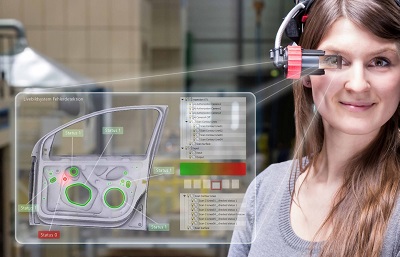 Presswork 4.0 takes data that is rarely evaluated and integrates it using an analysis and feedback system. Source: Fraunhofer IWU/Westsächsische Hochschule Zwickau/Tobias Phielertime and costs money while production is halted.
“We combine the various streams of data in our Linked Factory, a data and service platform developed here at the institute. From that, we generate new information that we can provide to staff, for example on mobile devices,” explained Sören Scheffler, a scientist at Fraunhofer IWU. “On the basis of this data, researchers are able to isolate the cause of a failure more quickly and make targeted suggestions to staff as to how to rectify it as quickly as possible.”
The team is starting with data that is already available through sensors, camera systems or other means of collection. As this data is often insufficient, the plan is to develop a software application that will collect the data in a central location and merge it with the other information to gain additional knowledge. In the example of the faulty door, the software will combine information on lubrication and the raw material with data from the machine tools sensors and determine which values are outside the predefined tolerance limits. The staff will receive troubleshooting options as well.
A long-term goal is the development of a warning system before a fault happens. “For instance, we could examine the material before it goes into production. Is a given sheet in good shape? If not, the employee can discard it before it is formed and other components are mounted onto it. In this way, resources are saved because we don’t have to throw away the entire assembly,” said Scheffler.
The researchers are implementing a combination of process sensors and active components to optimize the forming process window. The new information about the raw material could allow the press to compensate and balance out disturbances using smart guide shoes or adaptive warehousing, for instance, so that material does not end up as waste, Scheffler added.
“Based on my many years of experience in the industry, I understand users’ requirements and the potential Presswerk 4.0 offers. Thanks to intelligent connectivity between processes, machines, plants and people, we will establish new, autonomous control and cycle regulation as well as smart analysis and feedback systems geared toward users. This will shorten machine downtimes resulting from failures, reduce waste and energy use, expand the process window and overall align production more quickly and flexibly to customer requirements,” said Professor Dirk Landgrebe, Fraunhofer’s executive director.
Presswerk 4.0 will also give operators the flexibility to react quickly to changing market needs and customer preferences, even on short notice.
