
Researchers from Kumamoto University created a system that can quickly and easily measure food’s antioxidant levels. They hope that it will be used in quality control production, manufacturing and food product sale.
Some of the oxygen taken in by the body is converted into highly reactive oxygen species (ROS). Excessive ROS production can lead to a variety of health problems, including arteriosclerosis, cancer, aging and decreased immune function. Antioxidants stop the generation and function of ROS and even remove it.
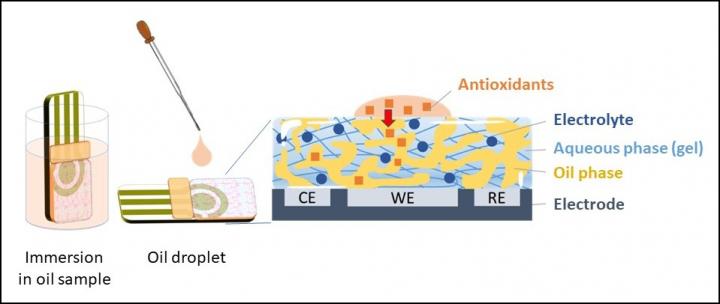 In this system, however, there is no need to prepare a new electrolyte solution because the gel. Source: Masashi Kunitake
Fat-soluble antioxidants are easily soluble in oil over water. Constant evaluation of antioxidants typically requires complex separation, extraction and colorimetric analysis. It is difficult to measure fat-soluble antioxidants in colorful and cloudy food samples.
(Learn more about colorimetric water analysis at GlobalSpec's Water Quality Photometers and Colorimeters information guide.)
The new electrochemical system uses a gel form called biocontinuous microemulsion (BME), integrated with a sheet-type electrode. The system creates an easy method to measure antioxidant capacity. This was achieved by creating a new BME gel and integrating it with sheet electrodes.
With the new system, a gel membrane is attached to the electrodes and then dipped into a sample. Analysis can also be done by placing a drop of the sample onto the electrode. With this method, even oily substances, which are not soluble, can be analyzed in their original state. This method does not require expensive equipment or special treatment. As a proof-of-concept, the team used the device to successfully measure the vitamin E in commercial olive oil.
The team hopes their system will contribute to more healthy food production worldwide.
A paper on the new system was published in Analytical Chemistry.
