
Researchers at CEA-Leti, France, have broken the throughput world record of 5.1 Gbps in visible light communications (VLC) using a single gallium nitride (GaN) blue micro-light-emitting diode (LED). Their data transmission rate of 7.7 Gbps achieved with a 10 µm microLED marks another step toward commercialization and widespread use of Li-Fi, or light fidelity, communication.
VLC is an emerging wireless communication system that offers an alternative or a complementary technology to radio frequency (RF) systems such as Wi-Fi and 5G. The technology is considered promising for security-related applications because light propagation can be confined to a room with no information leakage, as opposed to Wi-Fi communication, which penetrates walls. Li-Fi also holds promise for ultra-high speed data transmission in environments where RF emissions are controlled, like hospitals, schools and airplanes.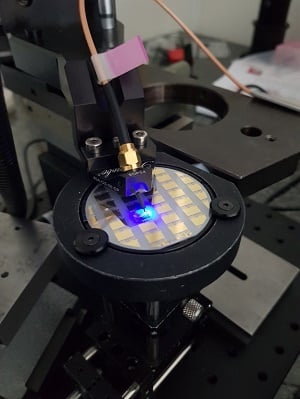 A single GaN blue microLED achieved a data-transmission rate of 7.7 Gbps. Source: CEA-Leti
Single microLED communications offer an ultra-high data-transmission rate for a variety of opportunities for new applications. These include industrial wireless high-speed links in demanding environments such as assembly lines and data centers, and contact-less connectors, or chip-to-chip communication. But their weak optical power limits their applications to short-range communications. In contrast, matrices of thousands of microLEDs contain higher optical powers than open mid- and long-range applications. However, preserving the bandwidth of each microLED within a matrix requires that each signal has to be brought as close as possible to the micro-optical source.
CEA-Leti’s expertise in the microLED epitaxial process produces microLEDs as small as 10 microns, which is among the smallest in the world. The smaller the emissive area of the LED, the higher the communication bandwidth – 1.8 GHz in the institute’s single-blue microLED project. The team also produced an advanced multi-carrier modulation combined with digital signal processing. This high-spectrum-efficiency waveform was transmitted by the single LED and was received on a high-speed photodetector and demodulated using a direct sampling oscilloscope.
In addition to a stand-alone Wi-Fi-like standard, the possibility to include this new technology as a component carrier in the downlink of 5G-NR, a radio-access technology for 5G mobile considerations, is also under investigation to bring a large additional license-free bandwidth.
