
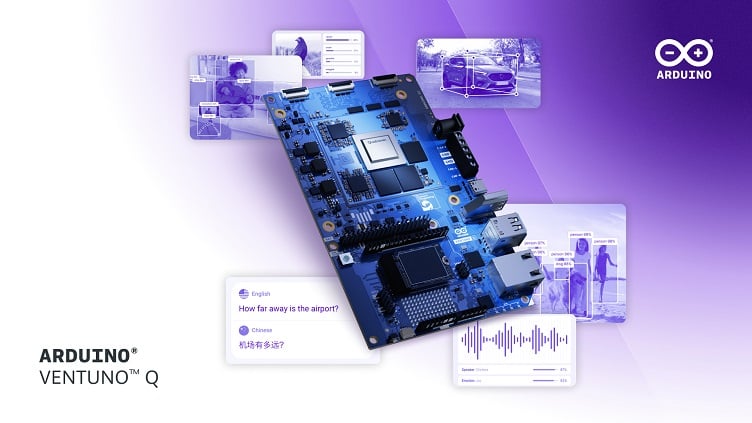
Arduino launched its latest platform at Embedded World 2026 called Ventuno Q, powered by Qualcomm Dragonwing IQ-8 series.
Arduino, which was acquired by Qualcomm in October of 2025, said the single board computer (SBC) builds on its UNO family and is designed for both traditional and generative artificial intelligence (AI) device creations. It includes an NPU acceleration delivering up to 40 tera operations per second (TOPS) as well as a dedicated STM32H5 microcontroller for low-latency actuation and motor control.
Other features of the SBC include:
- 16 GB RAM, expandable to 65GB
- Native CAN‑FD
- PWM high-speed GPIO
- ROS 2-ready workflows and robotics use cases
- Multiple MIPI‑CSI cameras
- Advanced audio
- Displays
- 2.5 Gb Ethernet
“With Arduino VENTUNO Q, AI can finally move from the cloud into the physical world,” said Fabio Violante, VP and GM for Arduino at Qualcomm. “This platform makes it possible to build machines that perceive, decide, and act — all on a single board.”
Violante said the goal is to make advanced robotics and edge AI accessible to all including developers, educators and makers.
The Ventuno Q will allow users to build AI-powered systems running AI like voice assistants running local large language models (LLM); smart mirrors that respond to gestures; tourist kiosks, healthcare desks or transport hubs that use automatic speech recognition (ASR) and text-to-speech at the edge.
In robotics, the SBC could run pick-and-place robotic arms guided by vision; service robots that follow owners across environments; and autonomous robots that navigate environments independently using visual SLAM and path optimization.
In edge AI vision and sensing, the Ventuno Q could provide security systems that spot hazardous behaviors; traffic monitoring devices for complex data on the edge; and automated quality inspections using local VLMs to detect defects or missing components.
Finally in education and research, Arduino said the SBC can be a tool to teach anything from computer vision to generative AI at the local edge.
Embedded World 2026 takes place this week in Nuremberg, Germany.
