The new PLF2000 series of liquid flow sensors from Posifa Technologies is designed to replace mechanical turbine flow sensors and deliver increased accuracy and reliability, even in unstable pulsatile flow and low-flow conditions. Factory calibrated for water to a minimum 5% and typical 3% accuracy for volume calculation, the 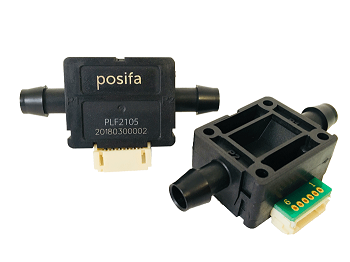 Source: Posifa TechnologiesPLF2000 series' dual digital inter-integrated circuit (I²C) and voltage output provides high performance, flexibility and scalability in a compact package.
The PLF2000 series features Posifa's third-generation thermal flow die, which uses a pair of thermopiles to detect changes in temperature gradient caused by mass flow. The result is an excellent signal-to-noise ratio and repeatability of 0.5% F.S. The solid-state thermal isolation structure on the sensor die eliminates the need for a surface cavity or fragile membrane used in competing technologies, allowing it to be placed directly in the liquid flow path with minimal packaging for higher sensitivity. In addition, the sensor die does not obstruct the flow path, allowing for minimal flow resistance and making it possible to circulate liquid via gravity, a boiler or a low-power pump. With no moving parts, the sensor does not get stuck, suffer mechanical breakdowns or require disassembly for cleaning and maintenance.
Measuring flow rates up to 700 ml/min (PLF2105) and 10 l/min (PLF2135), the devices offer extremely fast response times of 5 ms typical and operate over a +5° C to +75° C temperature range. The sensors comply with NSF/ANSI 61: Drinking Water System Components — Health Effects and can be used safely in water and beverage appliances. Posifa has the scalability and production capacity to meet any high-volume application, making the PLF2000 series one of the most cost-effective solutions on the market. Customers may contact the company to discuss options for customizing the sensors' specifications.
