
Sensors used in critical respiratory care and infusion applications face numerous challenges: damage from water condensation, the need to make periodic adjustments for drift and manufacturing costs that are usually too high for disposable devices. To address these issues, Posifa Technologies will highlight new solid-state micro-electro-mechanical systems (MEMS) mass air flow and liquid flow sensors at MD&M West 2020, held February 11-13 in Anaheim, California.
The cost-effective, reliable devices feature the company's third-generation thermal flow die, which eliminates the need for a surface cavity or the fragile membrane used in competing technologies, making the sensors resistant to clogging and pressure shock. For customers who prefer to design their own sensor modules, Posifa offers its MEMS flow die with minimal packaging. This allows original equipment manufacturers to speed integration of the sensors into their systems while maintaining proprietary control over the details of 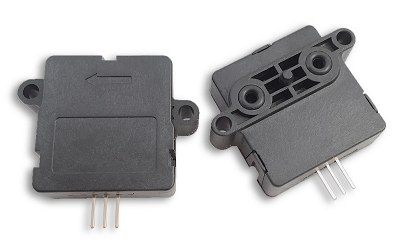 Source: Posifa Technologiestheir designs.
The PMF6000 series mass air flow sensors developed specifically for users wanting the flexibility of designing their own flow body and restrictor element will be demonstrated at the event. The devices' manifold-mount design eliminates the need for hoses and external connections, reducing the overall system size and the number of potential leak points. By utilizing the linearized factory calibration provided by Posifa, users can create master calibration curves specific to their custom bypass design with minimal additional corrections in the production process. Unlike off-the-shelf solutions, PMF6000 series sensors provide users with a competitive edge by allowing them to perform their own calibration and maintain the values within the company.
Also on exhibit will be the new PLF2000 series liquid flow sensors designed to replace mechanical turbine flow sensors and to deliver increased accuracy and reliability, even in unstable pulsatile flow and low-flow conditions. Featuring a silicon carbide protective film for direct contact with most liquids, the sensors’ thermal flow die enables higher accuracy than mechanical turbine devices while minimizing packaging costs. In addition, the sensors do not obstruct the flow path, allowing for minimal flow resistance and making it possible to circulate liquid via gravity, a boiler or a low-power pump. With no moving parts, the devices do not get stuck, suffer mechanical breakdowns or require disassembly for cleaning and maintenance.
