
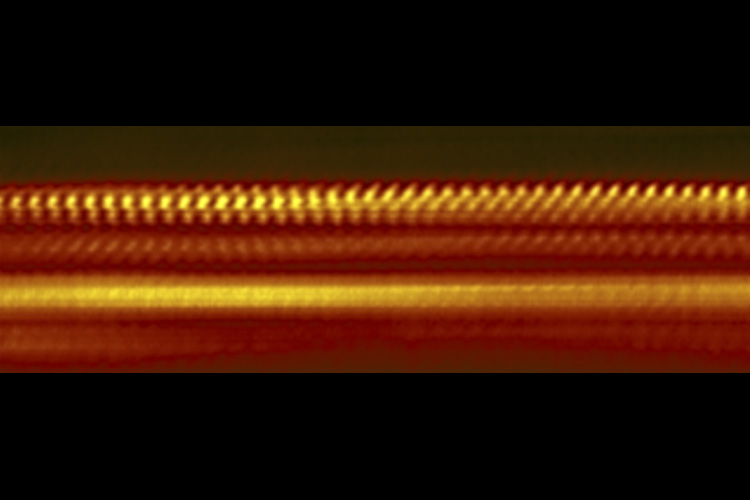
The heat-generating components in smartphones, laptops and other electronics can cause a host of problems, from user discomfort to device malfunctions to lithium battery explosions. The issue is typically pre-empted by inserting glass, plastic or layers of air as insulation. But new research at Stanford University has shown that the same protection can be offered by a few layers of atomically thin materials, which paves the way for electronic devices to be even more compact than they are today.
Perhaps what is most interesting about the research, however, is that it was based on thinking of heat as a form of sound.
That’s right: The heat one feels from a smartphone or laptop comes from electricity in the form of electrons flowing through wires. These electrons collide with the atoms of the materials they pass through, causing them to vibrate; as more current is added, more collisions occur. Ultimately, all those electrons beating on all those atoms creates a cacophony of vibrations moving through solid materials at high frequencies, outside the range of audibility. It’s that energy that is perceived as heat.
"We're looking at the heat in electronic devices in an entirely new way," said Eric Pop, a professor of electrical engineering and senior author of a paper published in Science Advances.
It was Pop’s background in college radio that prompted him to think about how sound is blocked in a recording studio — with thick panes of glass. The same principle could be applied to a heat shield, although simply making it thicker would defeat the purpose of reducing the size of devices. Borrowing a principle used in residential windows — installing multi-paned windows, which are typically comprised of layers of air between sheets of glass with varying thickness — proved the key to the new approach.
The Stanford team used a layer of graphene and three other sheet-like materials, each three atoms thick, to create a four-layered insulator just 10 atoms deep. Atomic vibrations are dampened as pass through each layer of the insulator, resulting in less heat getting through.
For nanoscale heat shields to be practical, however, the researchers will need to find a mass production technique to deposit atom-thin layers of materials onto electronic components during manufacturing. Beyond that goal is a larger ambition: to one day control the vibrational energy inside materials the way that electricity and light can be controlled today. As the understanding of heat in solid objects as a form of sound increases, a new field known as phononics is emerging. The term is named for the Greek root words behind telephone, phonograph and phonetics.
As Pop explained: "Engineers… know quite a lot about how to control electricity, and we're getting better with light. But we're just starting to understand how to manipulate the high-frequency sound that manifests itself as heat at the atomic scale.”

