
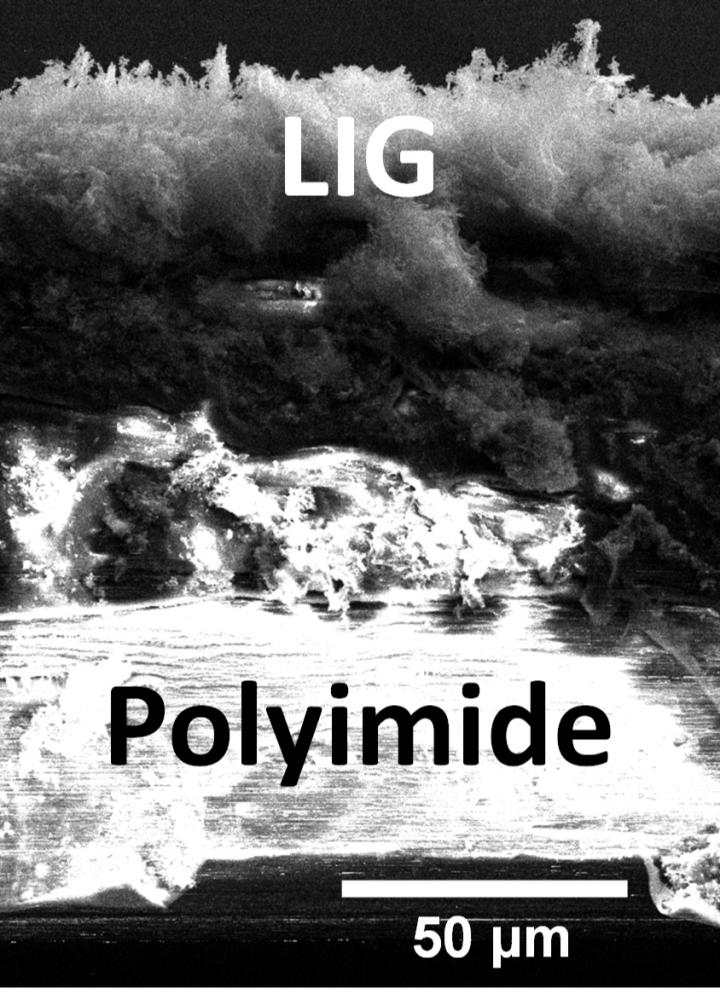
 An electron microscope image shows a cross-section of a laser-induced graphene and polyimide composite created at Rice University for use as a triboelectric nanogenerator. Source: Tour Group/Rice UniversityResearchers from Rice University have developed a material that harvests energy from wearables.
The material is an adapted laser-induced graphene (LIG) put into small, metal-free devices that can be worn to harvest energy. LIG is produced when chemicals are laser-heated on the surface of a polymer or other material, leaving behind flakes of 2D carbon. When LIG composites meet other surfaces, static electricity is produced in a process otherwise known as the triboelectric effect.
The team connected a folded strip of LIG to a string of LED lights. When the LIG strip was tapped, it produced enough energy to make the lights flash. They also attached a larger piece of LIG to a flip-flop sandal. When the person wearing the flip-flops walks, he or she produces energy. The repeated skin-to-LIG contact produced a current that was strong enough to charge a small capacitor. LIG was first put on common polyimide, but it has since been used with plants, food, treated paper, wood and more.
The best results came from materials that are at opposite ends of the triboelectric series. During the folding configuration, LIG from tribo-negative polyimide on electrodes was sprayed with a protective coating of polyurethane, which is a tribo-positive material. When the electrodes were brought together, electrons were transferred from the polyimide to the polyurethane and the transfer created energy. The folding LIG made 1 kilovolt (kV) of energy and remained stable after 5,000 bending cycles. The team determined that the best configuration was electrodes of polyimide-LIG composite and aluminum. These materials produced over 3.5 kV with a peak power of over 8 milliwatts (mW).
A paper on the new material was published in ACS Nano.
