
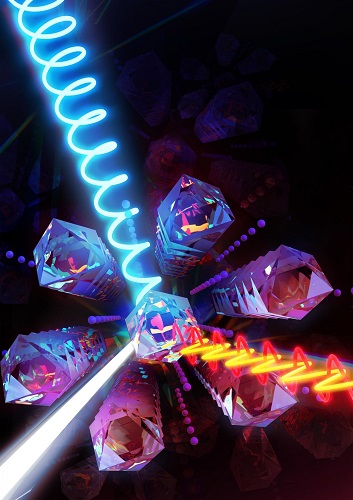
 An artist's rendering of how materials interact with light. Source: USC Viterbi School of EngineeringAutonomous vehicles will likely be the next big thing happening in the automotive market. But with numerous concerns over crashes and potential deaths due to the technology, ensuring these vehicles can detect and sense objects — even through dense fog — is paramount.
Infrared cameras offer much better visibility through fog, smoke or tiny particles that can scatter visible light-based cameras. They can also see better in the dark, but current deployment of these infrared cameras is limited by their high cost and scarcity of effective materials. These materials might make a difference in providing better object identification.
Now, researchers from the USC Viterbi School of Engineering, the University of Wisconsin, the Air Force Research Laboratory and the University of Missouri have developed a new material that might enable better infrared cameras in these autonomous vehicles.
The researchers are studying the new class of materials, called chalcogenide perovskites. They discovered that one material, barium titanium sulfide (BTS), interacted differently with light in two different directions.
"This is a significant breakthrough, which can affect many infrared applications," said Jayakanth Ravichandran, an assistant professor of materials sciences at the USC Viterbi School of Engineering.
The direction-dependent interaction with light is characterized by an optical property called birefringence, or light moving at different speeds in two directions. The BTS material has the ability to block or slow down light depending on the direction in which it travels in the material, similar to how sunglasses with polarized lenses block glare.
Using BTS, a sensor can be constructed to filter out certain light polarizations to achieve better image contrast. It could also help filter light coming from different directions to enable sensing of a remote object’s features. Researchers said this could be important for improving infrared vision in self-driving cars, which need to see the entire landscape around them even in low visibility conditions.
Researchers said the materials will allow for sensors to extend human perception, but they could also sense heat or temperature in other applications. These could take the form of a tool for firefighters that generates an instant temperature map outside a burning building to assess where the fire is spreading and how to better rescue trapped individuals. Other uses could be in devices that sense harmful molecules, gases or biological systems.
And because BTS is made from abundant elements, it could reduce the cost of infrared equipment to make it more affordable and effective.
The full research can be found in the journal Nature Photonics.
