
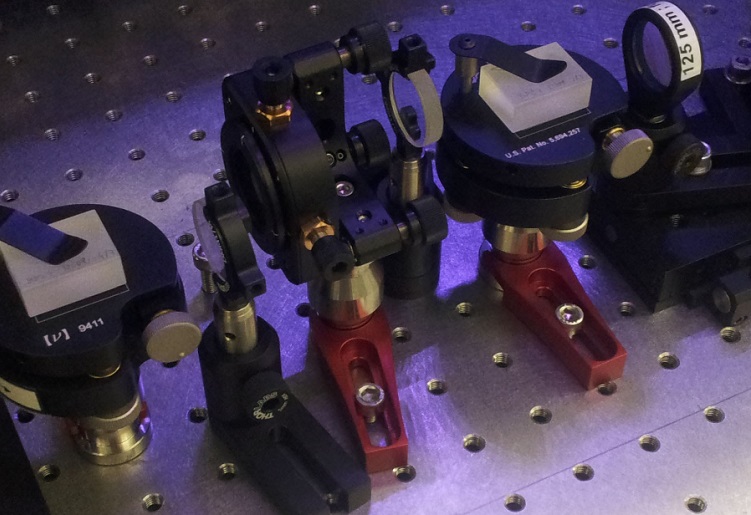
A better understanding of the boundary between the quantum and everyday classical worlds may be found in a “drumstick” made of light. A team of researchers have studied how it could cause a microscopic “drum” to both vibrate and stand still — at the same time.
Believe it or not, the emerging field of quantum optomechanics has used this very challenge as a benchmark goal. The counterintuitive behavior described by quantum theory is typically observed only in the microscopic realm, as opposed to being observable in everyday objects. Progress has been made toward that goal, but challenges remain. The present study takes an unconventional approach to generate quantum behavior in a tiny drum that is just visible to the naked eye.
According to Dr. Martin Ringbauer of the Australian Research Council (ARC) Centre of Excellence for Engineered Quantum Systems (EQUS) and lead author of the project, the team adapted a trick from optical quantum computing. “We used a measurement with single particles of light — photons — to tailor the properties of the drumstick,” he said. “This provides a promising route to making a mechanical version of Schrödinger's cat.”
The sound of a drum, of course, is created by mechanical vibrations; the drum skin rapidly moves up and down after being struck by a stick. The team’s experiments have made a crucial step forward for the field of quantum optomechanics: the first observation of a mechanical type of interference fringe — a term used to describe the bright or dark band of light caused by beams in or out of phrase with one another.
It should be noted that thermal noise caused these fringes to be at a classical level. But the team is currently at work on an improved technique that should allow operation of experiments at temperatures close to absolute zero — a range where quantum mechanics is expected to dominate.
Dr. Michael Vanner of Imperial College London, project principal investigator, said that systems such as the one the researchers created offer "significant potential for the development of powerful new quantum-enhanced technologies, such as ultra-precise sensors, and new types of transducers."
"Excitingly, this research direction will also enable us to test the fundamental limits of quantum mechanics by observing how quantum superpositions behave at a large scale," he added.
The research appear in the May 18, 2018, edition of New Journal of Physics.
