
One of the biggest complaints that computer and electronics users have is that the battery on their device doesn’t last long enough. The dream is to have a computer that only needs to be charged once a week or once a month. Then users wouldn’t have to worry about bringing their charger everywhere, or getting caught too with a dead computer in a vital moment. Another issue that laptop owners often run into is their computers overheating. When a computer is used for a long time, it tends to get hot and could overheat. Not only is this annoying, but it is also dangerous for the computer and potentially dangerous for the user. Researchers from the University of Missouri have developed a device that can solve these issues.
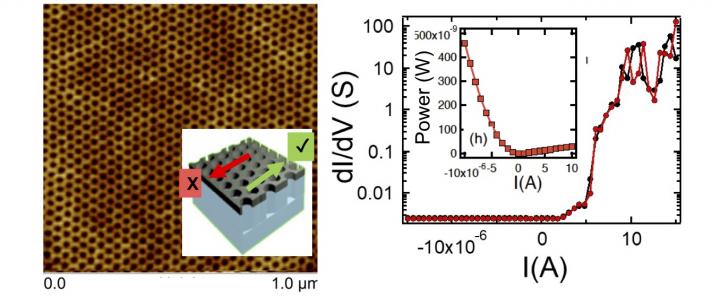 The left shows the atomic force micrograph, exhibiting honeycomb structure pattern behind a magnetic device. Inset shows the schematic of current flow direction. On the right: electrical data reveals diode-type behavior of current flowing in one direction. Source: Deepak Singh
"Semiconductor diodes and amplifiers, which often are made of silicon or germanium, are key elements in modern electronic devices," said Deepak K. Singh, the principal investigator of the Magnetism and Superconductivity Research Laboratory at MU and associate professor of physics and astronomy. "A diode normally conducts current and voltage through the device along only one biasing direction, but when the voltage is reversed, the current stops. This switching process costs significant energy due to dissipation, or the depletion of the power source, thus affecting battery life. By substituting the semiconductor with a magnetic system, we believed we could create an energetically effective device that consumes much less power with enhanced functionalities."
The new device could potentially extend the battery life of a laptop by 100 and decrease the heat that is produced by electronics. The device is made of a 2D nanostructure magnetic material that has a honeycomb structure, which is unique to this device and has many different electric properties. The material is made of a magnetic alloy that is put into a honeycomb template on top of a silicon surface. This device conducts an electrical current that only flows in one direction.
The material has less power than the semiconducting diodes that are currently used in laptops and other electronics. Less power may seem like a bad thing, but it’s actually not. Less power means that less heat is being conducted and the electronics are less likely to get really hot or overheat.
The magnetic diode opens a lot of new doors for more potential transistors and amplifiers to use this type of structure to produce less power. Along with lowered heat production, the lowered power production also allows these types of devices to have much longer battery life.
The first paper on this research was published in Advanced Electronics Materials, and the second paper was published in Advanced Science.
