Cellular data and Wi-Fi traffic are increasing more than ever. But the capacity of wireless links needs to be increased in order to handle all of this traffic. If the capacity is not increased, unnecessary bottlenecks will develop and they are detrimental to the process.
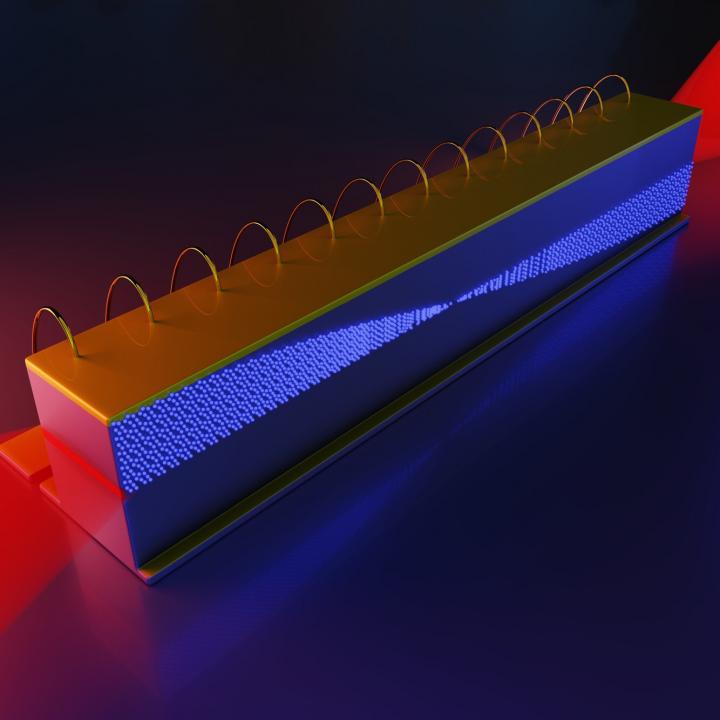 Inside an infrared frequency comb in a quantum cascade laser, the different frequencies of light beat together to generate microwave radiation. Source: Jared Sisler/Harvard University
5G networks are the networks of the future, according to many people. But they are really just a temporary fix to the capacity problem. Researchers have been searching for the solution in terahertz frequencies which are at a submillimeter wavelength on the electromagnetic spectrum. Data travels at terahertz frequencies to move hundreds of times faster than the frequencies of today’s wireless networks.
Researchers at the Harvard John A. Paulson School of Engineering and Applied Sciences (SEAS) discovered in 2017 an infrared frequency comb in a quantum cascade laser that could be the solution to create more terahertz frequencies. The same team of researchers has now discovered a new phenomenon of quantum cascade laser frequency combs. This new discovery allows devices to act as integrated transmitters or receivers to encode information.
"This work represents a complete paradigm shift for the way a laser can be operated," said Federico Capasso, the Robert L. Wallace Professor of Applied Physics and Vinton Hayes Senior Research Fellow in Electrical Engineering and senior author of the paper. "This new phenomenon transforms a laser — a device operating at optical frequencies — into an advanced modulator at microwave frequencies, which has a technological significance for the efficient use of bandwidth in communication systems."
Frequency combs are high-precision tools that are used for measuring and detecting different frequencies of light. Conventional lasers emit a single frequency, but these lasers emit multiple frequencies, evenly spaced to resemble the teeth of a comb, at the same time. Optical frequency combs are used in a wide range of things, like measuring fingerprints or detecting noise on other planets. But these uses are not what the research team was focusing on.
"We were interested in what was going on inside the laser, in the laser's electron skeleton," said Marco Piccardo, a postdoctoral fellow at SEAS and first author of the paper. "We showed, for the first time, a laser at optical wavelengths operates as a microwave device."
Different frequencies of light are beaten together to create microwave radiation inside the laser. The researchers found that light in the laser causes electrons to oscillate at microwave frequencies. These frequencies are within the communications spectrum. The oscillations can be externally modulated to encode information onto a carrier signal.
"This functionality has never been demonstrated in a laser before," said Piccardo. "We have shown that the laser can act as a so-called quadrature modulator, allowing two different pieces of information to be sent simultaneously through a single frequency channel and successively be retrieved at the other end of a communication link."
"Currently, terahertz sources have serious limitations due to limited bandwidth," said Capasso. "This discovery opens up an entirely new aspect of frequency combs and could lead, in the near future, to a terahertz source for wireless communications."
The paper on this new development was published in the journal Optica.
