
It’s a mess up there in low Earth orbit, with about 20,000 objects of 10 cm minimum diameter traveling at an 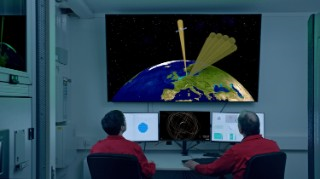 Electronically steerable antennas allow the tracking of space debris. Source: Fraunhofer FHRaverage speed of 25,000 km/hour. An additional 700,000 smaller objects compound the extraterrestrial debris problem, posing hazards for space missions and infrastructure.
A phased array radar system is under development in Germany to deliver continuous surveillance of such space debris. The German Experimental Space Surveillance and Tracking Radar (GESTRA) will be used to prepare an orbital data catalog, which will be instrumental in assessing and preventing collision risk. GESTRA is being engineered at the Fraunhofer Institute for High Frequency Physics and Radar Techniques and is expected to be deployed at the German Aerospace Center in mid-2019 to support continuous monitoring of debris at orbital heights of 300-3,000 km.
The compact, mobile GESTRA system integrates advanced semiconductor technology and an electronically steerable antenna to scan large areas of the sky within milliseconds. The sensor consists of a transmit and receive module, each encased in an 18 by 4 by 4 m housing.
