
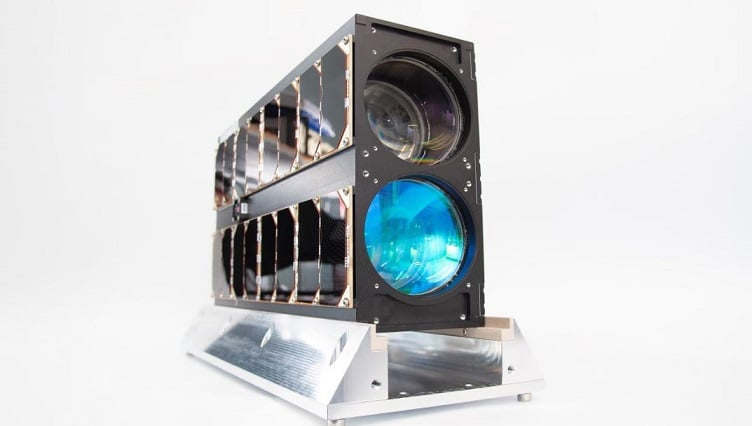
A Japanese-Finnish satellite agreement will lead to a planned multi-sensor constellation for dual-use applications across national security, economic security, resilience and civil use cases.
Japan’s IHI has signed a memorandum of understanding (MOU) with Finland’s Kuva Space to explore development and use of Kuva Space’s hyperspectral satellite capabilities as part of IHI’s sensor constellation.
The constellation is expected to include multiple satellite types like:
- Optical satellites
- Next generation automatic identification system
- Radio frequency and infrared
- Hyperspectral
- Synthetic-aperture radar (SAR)
IHI said that by combining these complementary sensor types, it will provide persistent and resilient intelligence for Japanese needs like target detection and tracking for land and maritime operations. Additionally, the constellation will support deeper cooperation with allies and like-minded nations through mutual sharing of satellite data and imaging capacity.
IHI has been conducting trials and verification of Kuva Space’s hyperspectral satellite data and AI-powered analysis methods. Under the agreement, the companies will prioritize use cases, define data and system requirements for a future hyperspectral satellite constellation. They will also explore business structures for developing hyperspectral satellite capabilities in Japan. This may include domestic satellite manufacturing.
Next phase of constellation
IHI has a partnership with Iceye, which has provided SAR data acquisition since April 2026. The MOU with Kuva Space marks the next phase to broaden its capabilities from all-weather SAR imaging to multi-sensor intelligence, the company said.
IHI is preparing to assemble and test two Iceye SAR satellites in Japan starting in September 2026 to further its domestic space capabilities.
In November, IHI launched a small hyperspectral satellite, the IHI-SAT2, and the collaboration with Kuva Space will further accelerate its hyperspectral satellite development and data exploitation, IHI said.
What is a hyperspectral satellite?
Hyperspectral satellites are equipped with hyperspectral sensors that can acquire information across a broader and more detailed range of wavelengths compared to conventional optical satellite imagery, Kuva Space said.
These satellites can analyze differences in reflection spectra from image data capture to estimate the material, condition and potential anomalies of target objects. This could include detecting and analyzing vegetation health, environmental conditions or other characteristics not visible through conventional optical technology.
Kuva Space launched its first satellite, dubbed Hyperfield-1A, in 2024 and its second satellite, Hyperfield-1B, was launched in 2025. Hyperfield-2 is slated to launch in 2027.
