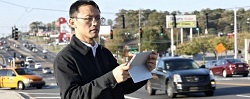
 Jidong Yang, assistant professor of civil engineering and director of Kennesaw State’s Georgia Pavement and Traffic Research Center, monitors a busy intersection in Marietta. Source: Rob Witzel
A two-year proof-of-concept study to develop an image-based system for monitoring and assessing the safety of road intersections is nearing completion.
Launched by Kennesaw State University and the Georgia Department of Transportation (GDOT) in January 2015, project participants are developing a software package that uses cameras currently installed at major intersections to extract traffic data in real-time. The data is then logged in a cloud-based database, which can be used to help the GDOT detect, analyze and correct any potential issues that could lead to vehicle accidents. The agency might use the information to realign roadways for improved line of sight, adjust speed limits for better compliance or add additional turn lanes.
The software application would supplement or replace the traditional practice of using historical crash data. It also provides a proactive way to monitor intersections before accidents occur.
“We’re trying to build certain artificial intelligence behind the cameras that can look at the images the same way a human can,” he said. “From those images, we’ll be able to extract and process conflict information automatically. We cannot afford to have people watching video 24 hours a day. We have to somehow automate the process,” says Jidong Yang, assistant professor of civil engineering.
The researchers are now testing their algorithms. Deep learning, an approach that gives computer programs a degree of intelligence, will allow the application to identify road users, such as vehicles, entering the intersection and track their positions and trajectory through the camera.
The program uses the trajectories extracted from live video to determine the direction and speed of the vehicles as they approach one another, and then determines the risk or probability of a collision. Over time, the application will log conflicts with a time stamp and information pertaining to the risk of collision.