
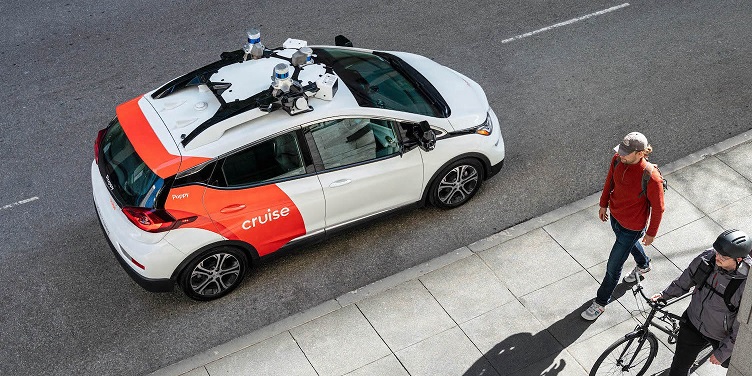
A new study from North Carolina State University finds that unconnected autonomous vehicles may hinder traffic speeds through intersections due to safety issues.
However, connected autonomous vehicles, those that share data with each other wirelessly, can significantly improve travel time through intersections.
“There are two significant reasons that people are interested in automated vehicles — improving passenger safety and reducing travel time,” said Ali Hajbabaie, associate professor of civil, construction and environmental engineering at North Carolina State University. “There is a lot of research showing that automated vehicles can improve safety. But our research here — which relies on computational modeling — suggests that if we want to also improve travel time, an increase in automated vehicles isn’t enough; we need vehicles that are capable of communicating with each other and with the traffic-control systems that manage traffic flow at intersections.”
The computational model simulates traffic conditions and was focused on four types of vehicles: human-driven vehicles (HVs); connected vehicles (CVs); automated vehicles (AVs); and connected automated vehicles (CAVs).
Hajbabaie said the AVs are more cautious to move compared to human drivers with the programming designed to drive conservatively. CVs and CAVs are designed to receive information about the future state of traffic lights and adjust speeds to avoid stopping at intersections. Therefore, these vehicles are expected to be smoother than HVs and AVs.
Traffic simulations
The researchers ran 57 traffic simulations to identify the impact of variables on travel time through an intersection. The researchers looked at how traffic would be affected by various combinations of HVs, AVs, CVs and CAVs.
They found that the more connected vehicles on the road, the easier traffic flowed through an intersection and more quickly on average. However, the more AVs at a traffic light actually slowed travel time through the intersections. This was due to the AVs being programmed to drive conservatively to reduce the risk of collisions.
Researchers said this underscores the importance of connectivity into both vehicles and traffic-control systems.
“This study was conducted using a computational model, which is a limiting factor,” Hajbabaie said. “However, it’s difficult and expensive to assemble a mixed fleet of HVs, AVs, CVs, and CAVs in a connected traffic-control system. Field tests involving human drivers can also raise safety concerns, making these modeling studies particularly important; we want to identify potential problems now, and not when real lives are at stake.”
The full research can be found in Sage Journals.
