
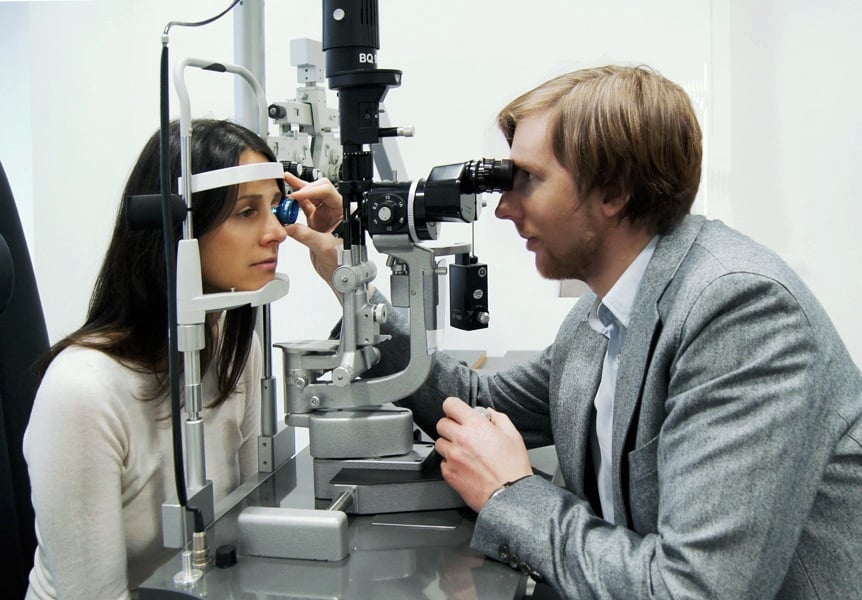
 An ophthalmologist who probably has EHR implemented in his practice. Source: PFrankoZeitz
The number of ophthalmologists using electronic health records (EHR) systems for storing and accessing patients’ medical histories has doubled between 2006 and 2016. But ophthalmologists’ perceptions of financial and clinical productivity following EHR implementations have declined, according to one study conducted by the UC Davis Eye Center.
"Our findings highlight the fact that companies that design EHR systems should further address the efficiency and usability of those systems," said lead author Michele C. Lim, vice chair and medical director of the UC Davis Eye Center.
The findings were based on a series of three questionnaire-based surveys. The most recent survey was conducted from 2015 to 2016, and was emailed to 2,000 randomly selected members of the American Academy of Ophthalmology. A total of 348 (17.4 percent) ophthalmologists responded to the survey. Similar surveys were conducted in 2011 and 2006.
According to the latest survey, 72.1 percent had implemented EHR, which is more than triple the rate from 10 years earlier. Ophthalmology practices linked with integrated government or university health systems were more likely to have integrated EHR.
Respondents who converted from paper to electronic record keeping were asked about productivity changes based on the number of patients they see every day. About 15 percent responded in 2006 that productivity had decreased as a result of EHR, but by 2016 more than half responded. Respondents were also asked how EHR affected overall practice costs. About 13 percent in 2006 said it resulted in increased costs while 75 percent said it resulted in increased costs in the most recent survey.
"The surveys reveal deepening dissatisfaction with utilizing EHR," Lim said. "Despite their dissatisfaction, however, only one-third of ophthalmologists surveyed said that they would return to paper records if they could, and more than half said they would not."
The Centers for Medicare & Medicaid Services (CMS) established incentives in 2011 to encourage hospitals and clinics to adopt and demonstrate meaningful use of certified EHR technology. At first, financial rewards were given for EHR adoption. More recently, financial penalties have been levied for non-compliance with EHR use.
According to survey results, qualifying for CMS incentives was deemed cumbersome and too costly by many providers.
"In a perfect world, EHR systems would help providers deliver efficient patient care and include a positive, user-friendly interface," Lim said. "EHR technology is evolving, and we will end up with such systems if appropriate stakeholders, including healthcare professionals who use EHR, and those who design them work together."
The study on this research was published in JAMA Ophthalmology.

