
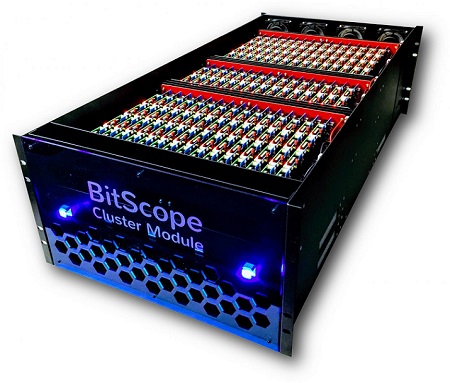
 The BitScope Pi Cluster Modules system. Image credit: BitScope.Developing software for a supercomputer, but can’t swing the quarter-billion dollars or the 25 megawatts of electricity need for a testbed? There’s always Raspberry Pi.
A system conceived by Gary Grider, leader of the High Performance Computing Division at Los Alamos National Laboratory, uses thousands of Raspberry Pi nodes to create an affordable, scalable, high-performance testbed alternative for the systems software community.
"It's not like you can keep a petascale machine around for R&D work in scalable systems software," Grider says. “The Raspberry Pi modules let developers figure out how to write this software and get it to work reliably without having a dedicated testbed of the same size.”
The new solution was designed and built by BitScope and distributed by SICORP. "Having worked with Raspberry Pi for quite some time, I've long thought it the ideal candidate to build low-cost cloud and cluster computing solutions for research and education," says BitScope CEO Bruce Tulloch. "When SICORP approached us with Gary's plans, we jumped at the opportunity to prove the concept."
BitScope’s system consists of five rack-mounted Pi Cluster Modules, each with 150 four-core nodes of Raspberry Pi ARM processor boards. That’s a total of 750 CPUs or 3,000 cores, fully integrated with network switching infrastructure – ample for enabling developers to build, scale and test software before launching it onto supercomputers like Trinity, which is housed at Los Alamos.
There are other potential applications, including large-scale sensor networks, with flexible I/O to connect the actual sensor devices; high-performance computing (HPC) network topology research, to improve production performance; and the internet of things.
Developed in the U.K. to help spread computing in education and developing countries, Raspberry Pi is an inexpensive, credit-card sized computer that can do just about anything a typical desktop computer can do. Basic models, which consume only 2 to 3 watts of power, start at about $25.
