
Researchers studying the flow of electricity through semiconductors have revealed another reason these materials seem to lose their ability to carry charges as they become densely “doped.” These results may help engineers design faster semiconductors in the future.
Semiconductors are found in almost every piece of modern electronics like computers, televisions or cell phones. They fall between metals that conduct electricity well and insulators like glass that don't conduct electricity at all. The moderate conduction property is what allows semiconductors to perform as switches and transistors in electronics.
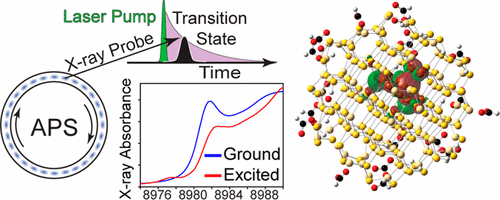 Understanding the electronic structure of doped semiconductors is essential to realizing advancements in electronics and in the rational design of nanoscale devices. Source: University of Illinois, Chicago
A common material for semiconductors is silicon that has been mined from the earth, refined and purified. Pure silicon doesn’t conduct electricity so the material is purposely altered by the addition of other substances called dopants. Boron and phosphorus ions are common dopants added to silicon-based semiconductors that allow users to conduct electricity.
The amount of dopant added to a semiconductor can change the effects the semiconductor has. Too little dopant and the semiconductor won’t be able to conduct electricity, and too much dopant and the semiconductor becomes a non-conductive insulator.
"There's a sweet spot when it comes to doping where the right amount allows for the efficient conduction of electricity, but after a certain point, adding more dopants slows down the flow," says Preston Snee, associate professor of chemistry at the University of Illinois, Chicago and corresponding author on the paper. “For a long time scientists thought that the reason efficient conduction of electricity dropped off with the addition of more dopants was because these dopants caused the flowing electrons to be deflected away, but we found that there's also another way too many dopants impede the flow of electricity."
Snee and his team wanted to get a closer look at what happens when electricity flows through a semiconductor.
At the Advanced Photon Source at Argonne National Laboratory, the researchers were able to capture X-ray images of what happens at the atomic level inside the semiconductor. They used chips of cadmium sulfide for their semiconductor “base,” then doped them with copper ions. Instead of wiring the chips for electricity, the team generated a flow of electrons through the semiconductors by shooting them with a powerful blue laser beam. At the same time, they took high-energy X-ray photos of the semiconductors at millionths of a microsecond apart. This showed what was happening at the atomic level in real time as the electrons flowed through the doped semiconductors.
The team found when the electrons were flowing through, the copper ions transiently formed bonds with the cadmium sulfate semiconductor base. This is detrimental to conduction.
"This has never been seen before," said Hassan. "Electrons are still bouncing off dopants, which we knew already, but we now know of this other process that contributes to impeding the flow of electricity in over-doped semiconductors."
A paper on this research was published in ACS Nano.
