
Scientists are now using spectroscopy—the study of how light interacts with trace amounts of matter—to search for traces of drugs, bomb-making components and other dangerous chemicals. Absorption spectroscopy is being used by scientists to search for performance-enhancing drugs in blood samples and tiny explosive particles in the air.
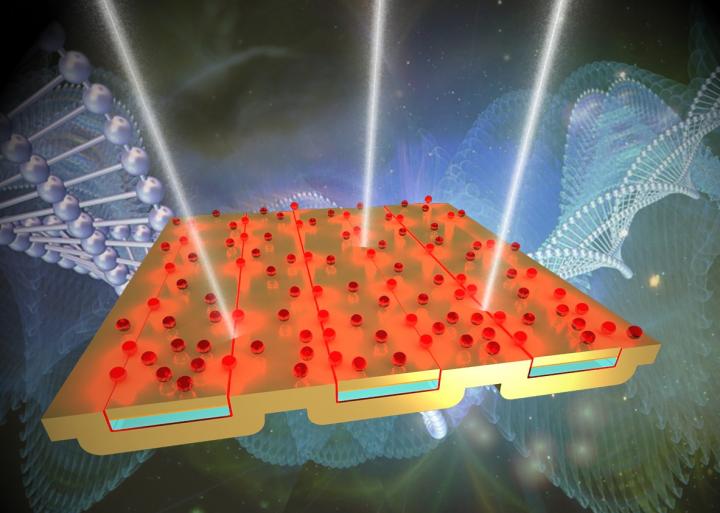 The image above depicts a new device for surface enhanced infrared absorption spectroscopy. Infrared light (the white beams) is trapped by tiny gaps in the metal surface, where it can be used to detect trace amounts of matter. (Source: University at Buffalo)
Infrared absorption spectroscopy has improved greatly in the last 100 years, but there is still work to be done to make the technology more sensitive, inexpensive and versatile. A team of engineers from University at Buffalo (UB) has developed a new light-trapping sensor that is a step towards progress in all three of these areas.
"This new optical device has the potential to improve our abilities to detect all sorts of biological and chemical samples," says Qiaoqiang Gan, Ph.D., associate professor of electrical engineering in the School of Engineering and Applied Sciences at UB, and the study's lead author.
The sensor works with light in the mid-infrared band of the electromagnetic spectrum. This spectrum is usually employed in remote controls, night vision and other applications.
The sensor has an insulator sandwiched between two layers of metal. Researchers used a fabrication technique called atomic layer deposition to create a device with gaps less than five nanometers between the two metal layers. These small gaps enable the sensor to absorb up to 81 percent of infrared light, a significant improvement from the 3 percent that other devices absorb.
This process is known as surface-enhanced infrared absorption (SEIRA) spectroscopy. The sensor acts as a substrate for the materials being examined and boosts the sensitivity of SEIRA devices to detect molecules at 100 to 1,000 times greater resolution than previously reported.
SEIRA spectroscopy is comparable to another type of spectroscopic analysis called surface enhanced Raman spectroscopy (SERS). SERS measures light scattering as opposed to absorption.
The SEIRA advancement could be useful in all scenarios that call for finding traces of molecules, including but not limited to drug detection in blood, bomb-making materials, fraudulent art and tracking diseases.
A study on this research was published in Advanced Optical Materials.
