
Mid-infrared (mid-IR) hyperspectral imaging has varied applications in medical diagnostics, environmental monitoring and other fields, but its deployment is hindered by the need for complex and costly detectors and light sources. An economical fix engineered by an international research team focused on a new upconversion system to transform mid-IR into near-IR wavelengths that are more readily processed by available camera 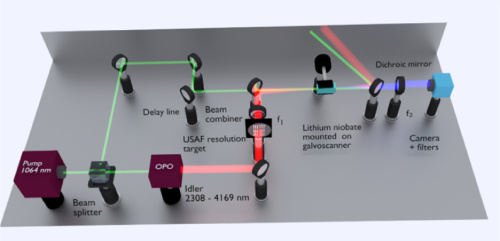 Setup for the upconversion-based imaging. Source: S. Junaid et al./ Optical Society of Americaequipment.
Nonlinear frequency conversion, a method of boosting the energy of photons, was applied to shift the wavelength of incoming light to the near-IR range while preserving all the spatial information. The upconversion system incorporates a newly developed mid-IR light source that can be tuned to different wavelengths. The researchers demonstrated use of the same pulsed near-infrared laser for two applications: to generate the tunable mid-IR light and to achieve the image upconversion.
The imaging speed of the mid-IR upconversion spectroscopy system was confirmed by tuning the illumination laser to match the peak absorption of a gas flow and acquiring a video with 40 images per second. Its potential utility for medical diagnostics was also assessed in an evaluation of cancerous and healthy esophageal tissue samples. Both the morphology and spectral classification determined with the new system were consistent with conventional histopathology imaging.
The study conducted by scientists from Technical University of Denmark, Barcelona Institute of Science and Technology, University of Exeter, NHS Foundation Trust and Institucio Catalana de Recerca i Estudis Avancats (Spain) is published in Optica.
