
Due to limited access to early diagnostics, the survival rate of breast cancer patients, for example, is only 40 percent in low-income nations—half the rate of such patients in developed nations. Other deadly diseases, such as malaria, tuberculosis and HIV, also have high incidence and poor patient outcomes in developing countries. However, researchers believe better access to cheap diagnostics could help turn this around.
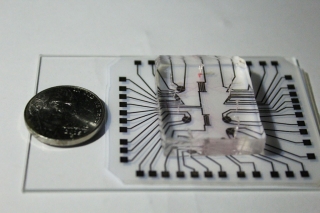 The lab on a chip includes a clear silicone microfluidic chamber for housing cells and a reusable electronic strip—a flexible sheet of polyester with commercially available conductive nanoparticle ink. Credit: Zahra Koochak/Stanford “Enabling early detection of diseases is one of the greatest opportunities we have for developing effective treatments,” said lead researcher Dr. Rahim Esfandyarpour, an engineering research associate at Stanford’s genome center. “Maybe $1 in the U.S. doesn’t count that much, but somewhere in the developing world, it’s a lot of money.”
How It Works
The lab on a chip is a two-part system. The first is a clear silicone microfluidic chamber for housing cells and a reusable electronic strip. The second part is a regular inkjet printer that can be used to print the electronic strip onto a flexible sheet of polyester using commercially available conductive nanoparticle ink.
“We designed it to eliminate the need for clean-room facilities and trained personnel to fabricate such a device,” said Esfandyarpour. “One chip can be produced in about 20 minutes.”
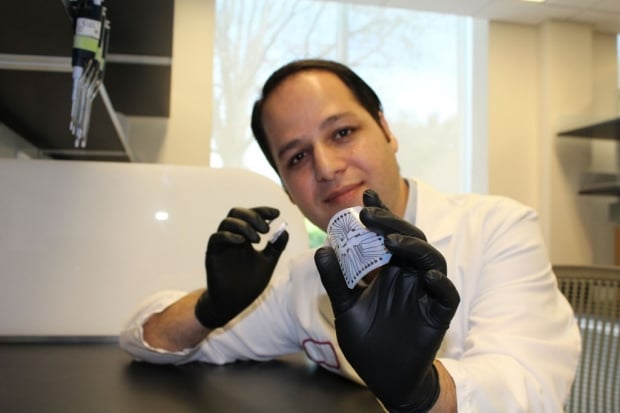 Dr. Rahim Esfandyarpour and the biochip he helped create for just a penny. Credit: Zahra Koochak/Stanford Designed as a multifunctional platform, one of the chip’s applications is that it allows users to analyze different cell types without using fluorescent or magnetic labels typically required to track cells, researchers said. Instead, the chip separates cells based on their intrinsic electrical properties.
When an electric impulse is applied across the inkjet-printed strip, cells loaded into the microfluidic chamber get pulled in different directions depending on their “polarizability” in a process researchers called dielectrophoresis. This label-free method to analyze cells greatly improves precision and cuts lengthy labeling processes, they said.
The tool is designed to handle small-volume samples for a variety of assays. Researchers showed that the device can help capture single cells from a mix, isolate rare cells and count cells based on cell types, yet the cost of these multifunctional biochips is a mere fraction of that of conventional laboratory equipment.
The technology has the potential not only to advance health care, but also to accelerate basic and applied research, Esfandyarpour said, by allowing scientists and clinicians to potentially analyze more cells in shorter time periods, manipulate stem cells to achieve efficient gene transfer and develop cost-effective ways to diagnose diseases.
Researchers suggest the chip will create a transformation in how instruments are used in the lab. “I’m pretty sure it will open a window for researchers because it makes life much easier for them—just print it and use it,” he said.
