
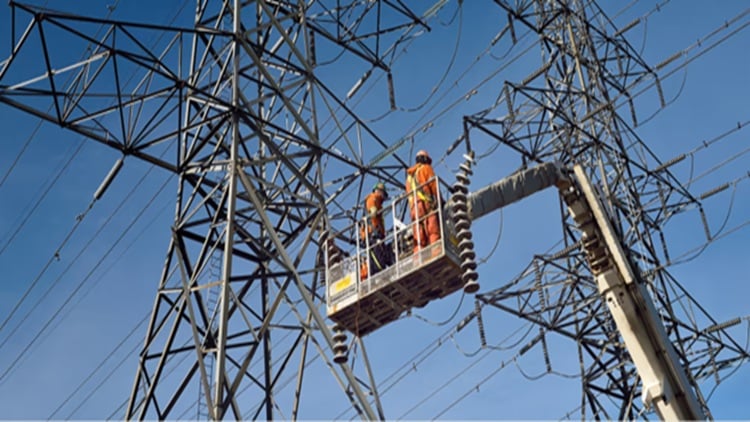
When most of North America's and Europe's transmission towers were erected, household air conditioning was a luxury, data centers did not exist and nobody was charging a car from a wall socket. The wire strung between those towers — aluminum conductor steel-reinforced wire (ACSR) — was well-matched to that world.
The aluminum outer strands carry the current around a steel core that provides tensile strength. Steel, however, expands thermally at roughly three times the rate of aluminum. As operating temperature rises, the steel core elongates faster than the surrounding strands, pulling the conductor into sag that reduces ground clearance and forces utilities to derate thermal ampacity below the line's physical capacity. The tradeoff was manageable as long as demand grew slowly, and new corridors got built. Both assumptions have since collapsed.
A new transmission corridor takes 10 to 15 years to permit, review and litigate into existence. That clock does not align with load curves driven by data centers, factory electrification and electric vehicle (EV) infrastructure — demand that utilities are already obligated to serve. For engineers, reconductoring established tower lines is the logical move. Advanced wire is installed on existing structures and connects through existing rights-of-way to existing substations.
How advanced conductors differ from ACSR
Advanced conductors replace the steel core with a composite of carbon fiber and glass fiber strands embedded in thermoset epoxy resin. That substitution produces two measurable outcomes. The composite core has a coefficient of thermal expansion roughly 90% lower than steel. At 200° C operating temperature, the conductor stays taut and sag remains within ground clearance limits — and sag is the physical constraint that caps thermal ampacity on most transmission segments. Reducing it directly raises the current a line can carry without touching tower structures. In documented reconductoring projects, composite-core conductors can double the ampacity — that is a 100% increase within the same right-of-way.
The second outcome follows from the core's weight. Because the composite core is lighter than steel, more cross-sectional area is occupied by aluminum. A composite-core conductor holds 28% more aluminum than an equivalent-diameter ACSR — a higher proportion within the same outer diameter, not simply more total mass. The additional aluminum lowers DC resistance, which reduces resistive (I²R) losses while raising current capacity at the same conductor diameter and tower load.
Three composite-core conductor families dominate current reconductoring projects. Aluminum conductor composite core (ACCC), developed by CTC Global, uses a carbon and glass fiber core and has been deployed across more than 1,325 projects in 67 countries since 2004, making it the most field-tested composite-core conductor. Aluminum conductor composite reinforced (ACCR), developed by 3M, uses an aluminum oxide fiber composite core suited to high-temperature and wildfire-prone corridors. Aluminum encapsulated carbon core (AECC), from TS Conductor, uses a carbon core encapsulated in aluminum and is designed around standard ACSR compression tooling, reducing hardware procurement scope on retrofit projects.
Aluminum conductor steel supported (ACSS), takes a different approach — it retains a steel core with fully annealed aluminum strands, which improves ampacity over ACSR but leaves sag as a constraint on clearance-limited lines.
Structural parameters and capital efficiency
Research published in PNAS in September 2024 modeled all 53,000 U.S. transmission segments and found reconductoring could deliver nearly four times as much interzonal capacity by 2035 at marginally higher total investment than greenfield new-build. GridLab's April 2024 cost analysis explains why: avoided right-of-way acquisition and tower construction account for the majority of new-build expense, putting reconductoring at less than half the per-mile cost.
A 230-kV double-circuit line carrying 500 MW with ACSR may lose around 20 MW to resistance at full load. ACCC's resistance runs approximately 25% lower, recovering 8 MW or more — generation the utility already produces but cannot fully deliver. At grid scale, reconductoring 25% of lines due for replacement this decade could interconnect 270 GW of zero-carbon capacity and save consumers an estimated $140 billion, per an EPRI-backed assessment.
Installation and specification considerations
Tower structure assessment
Tower structures appearing adequate from the ground may not be rated for the tension loads a larger conductor bundle introduces. Advanced conductors of equivalent diameter are generally lighter than ACSR, but projects that increase aluminum cross-section or raise operating temperature increase tension loading at dead-end and line-angle structures. A dead-end structure on a 345 kV line was not designed for the horizontal pull of a larger conductor bundle — exceeding its rated load forces either tower reinforcement or full structure replacement, adding capital cost to a project financially justified on the assumption that towers stay unchanged. According to a UC Berkeley and GridLab study published in PNAS, reconductoring projects typically cost less than half the price of comparable new-build transmission lines because they reuse existing rights-of-way and structures. This cost model works only when towers stay unchanged — which is why a structural audit of existing lattice towers and poles is a prerequisite before conductor type is finalized.
Hardware and fitting compatibility
ACCC conductors go through a separate hardware qualification process from ACSR. Compression dead-end and splice fittings operate at higher compression ratios, and an aluminum sleeve must be inserted over the composite core before crimping — a step needing a dedicated hydraulic tool absent from a standard transmission crew's kit. Skipping the sleeve risks core damage that may not be visible externally but compromises rated tensile strength. Clamps, vibration dampers and spacers all need manufacturer verification for composite core compatibility before procurement. TS Conductor, which holds the proprietary AECC design, engineers the conductor around standard ACSR tooling and compression fittings, reducing hardware qualification scope and pre-job preparation time on retrofit projects.
Stringing and crew training
Composite core conductors have a field reputation for core damage under improper handling. American Electric Power's ACCC installation on a 345 kV line in Texas produced three core breaks during stringing. The first occurred when the puller ran free, the conductor lost tension on the bull wheels, jumped the wheel track and contacted the axle at a small-radius bend — rupturing the core strand. The company retrained the crew and completed the project without further failures, achieving a 75% capacity increase on the reconductored circuit.
The failure mode points to a direct requirement: conductor tension must be maintained continuously, sheave wheel diameters must meet the manufacturer's minimum bend radius and the conductor must not contact hard metal surfaces during pay-out. On a crew's first composite core deployment, manufacturer stringing guidelines and a pre-job briefing are non-negotiable regardless of experience level.
Conclusion
Advanced conductors solve a specific problem: how to move more current through an existing transmission corridor without building new towers or acquiring new right-of-way. Therefore, reconductoring is not a compromise forced by permitting delays. It is a transmission upgrade method with a documented cost advantage, a growing body of field results and a regulatory mandate behind it. The PNAS study quantified what American Electric Power demonstrated on a 345 kV corridor in Texas: capacity doublings on existing structures at less than half the cost of new-build. FERC Order 1920, effective August 2024, formalized the evaluation requirement — transmission providers are required to document how they considered advanced conductors in any upgrade assessment, which means a default return to ACSR replacement no longer holds up in a planning study.
For the utility engineer evaluating a transmission upgrade, the conductor choice — ACCC, ACCR, AECC — depends on what the existing towers can carry, what compression hardware the procurement team can qualify and what the crew has been trained to install. Those three factors decided the outcome on every early ACCC deployment that encountered problems — and on every one that did not. Getting them right at project outset is what the available field data consistently shows makes the difference.
About the author
Alexander Muchoki combines his background as an electrical engineer with over a decade of experience writing about customer education and product marketing in energy, manufacturing, and industrial technology. Outside work, he enjoys hiking, running and family time.
