
University of Wisconsin-Madison engineers have created the world’s fastest stretchable, wearable integrated circuits, an advance that could drive the Internet of Things and provide for, among other applications, epidermal patches that allow hospital staff to monitor patients remotely and wirelessly.
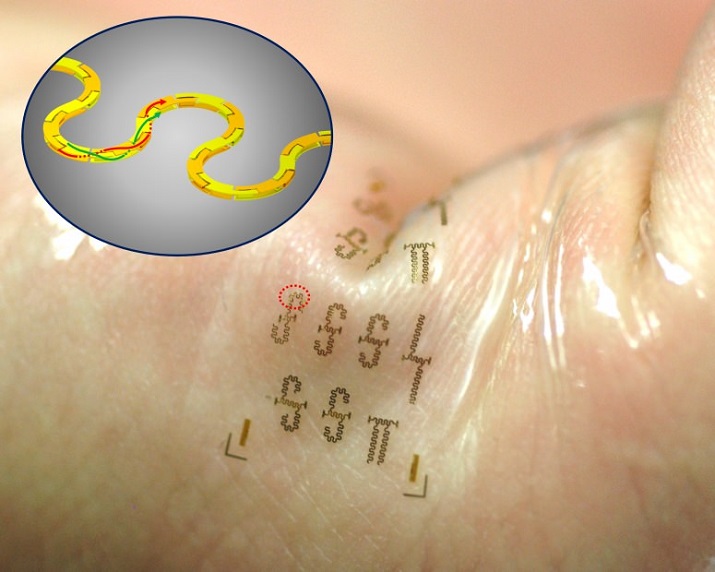 The stretchable integrated circuits could be used in wearable electronics that adhere to the skin like a temporary tattoo. Because the circuits increase wireless speed, they could be used in healthcare settings to allow staff to monitor patients remotely, without the use of cables and cords. Source: Yei Hwan Jung and Juhwan Lee, University of Wisconsin-MadisonThe team, led by engineering professor Zhenqiang “Jack” Ma, has been working to develop what are known as transistor active devices. This latest advance marries the group’s expertise in both high-frequency and flexible electronics, creating a way to integrate high-frequency active transistors into a useful circuit that can be wireless.
Inspiration for the powerful new circuits came from twisted-pair telephone cables. They contain two tiny intertwining power transmission lines in repeating S-curves. As explained by the researchers, this serpentine shape, formed in two layers with segmented metal blocks, gives the transmission lines the ability to stretch without affecting their performance. It also helps shield the lines from outside interference and, at the same time, confines the electromagnetic waves flowing through them, almost completely eliminating current loss.
Currently, the stretchable integrated circuits can operate at radio frequency levels up to 40 gigahertz. This makes them particularly suited to take advantage of a new generation of wireless broadband technologies known as 5G, which uses frequencies in the 0.3 to 300 gigahertz range.
And, unlike other stretchable transmission lines, whose widths can approach 640 micrometers, or 0.64 millimeters, these stretchable integrated circuits are just 25 micrometers, or .025 millimeters, thick, tiny enough to be effective in epidermal electronic systems, among other applications.
