
As companies strive to miniaturize electronics, they must also decrease the size of the components. The demand for thinner and lighter devices is often met with the challenge of oddly shaped energy sources that must be used in order to make them conform to the smaller space.
Researchers from the University of Missouri have developed a way to transfer an energy source to virtually any shape. The team used an efficient laser-writing technique that could potentially help smartphone manufacturers create energy storage units, such as microbatteries and micro fuel cells that are more environmentally friendly and thin.
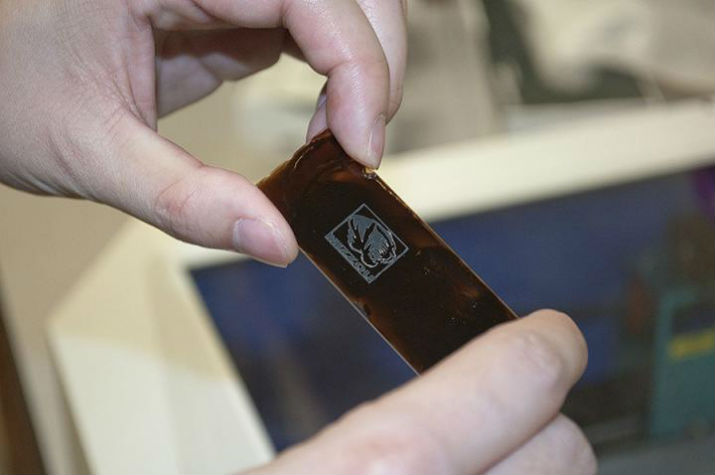 Lin and the team developed a technique using direct laser writing methods. (Image Credit: Ryan Owens, College of Engineering)"The direct laser writing (DLW) method and technique has seen a rapid advancement in the past decade," said Jian Lin, an assistant professor in the Department of Mechanical and Aerospace Engineering in the MU College of Engineering. "The main goal of our research was to find an efficient and cost-effective way to integrate nanostructures with micro energy storage units for applications in micro-electronics. Our lab decided to test whether catalysts could be synthesized and patterned on any surface by a one-step laser processing method to produce microbatteries and micro fuel cells in the shapes dictated by computer programs."
Lin and the other team members adapted the DLW method to synthesize and pattern hybrid fuel sources into complex geometric shapes. The scientists were able to create an electrically conducive surface with catalytic properties using computer-controlled laser writing that uses higher heat and pressure.
The team believes this is the first step toward manufacturing micro fuel cells capable of converting chemical energy into electrical energy, as well as batteries that can be integrated into microcircuits.
“By honing the process, handheld device and smartphone manufacturers will be able to produce components in whatever shape or size they choose, greatly impacting the size of these devices,” said Lin. Also, manufacturers will be able to choose more environmentally friendly catalysts for generating energy such as hydrogen or oxygen, which are considered cleaner fuels. The possibilities will be endless."
