Key takeaways:
- Connectors are a major but overlooked enabler of higher data rates in data centers and in aerospace and defense systems.
- Vendors raise bandwidth by cutting impedance discontinuities, using shorter pins, BGA footprints, smaller pin pitch and controlled differential pairs.
- Rugged aerospace computing is following the data center path, with VPX connector rates rising from about 6.25 Gb/s to at least 25 Gbaud and 100 Gb/s per lane in development.
It’s always the case that the chip designers, fabs and big-name companies get all the attention, especially when it comes to faster data rates and higher compute capabilities in networked systems. That’s exactly what we’ve seen in the technology media and financial media and it helps explain why companies like Micron and Nvidia have seen their stock prices rise to stratospheric valuations.
But the reality is that none of these companies exists in a vacuum and there is one class of components that quietly enables the connectivity that powers digital experiences, regardless of whether they use artificial intelligence. These components are connectors and they have been a major enabler of higher data rates inside and outside the data center.
A host of other applications, particularly in defense and aerospace, are continuing to push data rates progressively higher as they implement more compute and functionality that would normally be found on the ground or in the cloud. Whether you’re designing for the data center or low-Earth orbit, connectors have become a major enabler of higher data rates in modern digital systems.
How do connector vendors push bandwidth higher?
Connector vendors have progressively found ways to increase bandwidth in designs to support higher data rates across a range of applications, largely by reducing impedance discontinuities in the contact structure and printed circuit board (PCB) transitions. As data rates increase, connector manufacturers have reduced these discontinuities through several changes:
- Shorter pins and solder tails to reduce the stub created at the PCB interface
- Ball grid array (BGA) and other surface-mount footprints to eliminate long plated through-hole transitions
- Smaller pin pitch and contacts to reduce parasitic inductance and capacitance
- Interleaved ground pins to limit crosstalk between tightly packed signals
- Controlled differential-pair geometry through the connector to reduce skew and mode conversion
In general, these changes have accompanied higher pin densities, increasing total connector bandwidth by placing more channels into the same area. “Those stubs are a real issue,” said Shane Dabrowski, field applications engineer at Samtec. “As the digital connectors are used for higher-frequency designs, the pitch and the contact needs to start getting smaller. So these contact styles are getting smaller and smaller.”
The other changes increase the usable bandwidth of each channel by shortening the interconnect and reducing impedance discontinuities. At the highest data rates, the connector footprint and PCB breakout can each become the bandwidth-limiting element, and they must be designed to avoid reflections and resonances that degrade the signal.
Aerospace sees much higher compute
Rugged embedded computing follows the same trajectory as the data center to support advanced computing applications in standard form factors that are demanded on the battlefield and in spacecraft. New processing cards combine higher core counts with FPGA or GPU-class acceleration and sensor interfaces. Radar, electronic warfare, signals intelligence and electro-optical/infrared (SIGINT and EO/IR) systems increasingly must move large data sets between acquisition, processing, storage and networking functions inside the chassis.
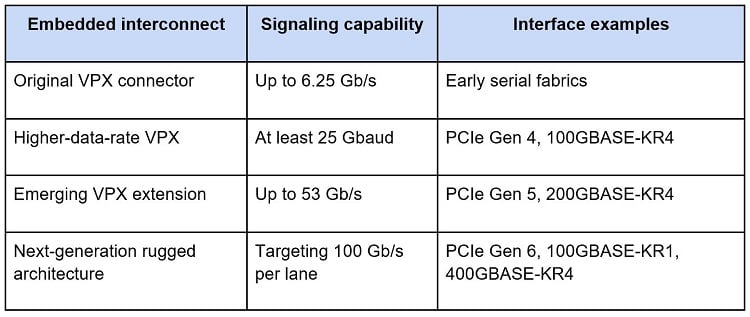
That growth is visible in the interconnect standards. Early VPX hardware used connectors rated around 6.25 Gb/s, but the newer higher-data-rate VPX variants support at least 25 Gbaud for PCIe Gen 4 and 100GBASE-KR4 Ethernet, while a newer connector standard under development targets 53 Gb/s for PCIe Gen 5 and 200GBASE-KR4. Next-generation rugged architectures are also being developed around 100 Gb/s per lane and PCIe Gen 6.
 zach_chart
High data rates and filtering
Higher channel bandwidth does not remove the electromagnetic compatibility problem at the connector. External cables remain paths for conducted interference, common-mode current and radiated coupling. If that energy crosses the enclosure boundary before it is filtered, it can propagate through PCB routing and cabling into processors, sensors, power networks and communication interfaces.
One approach is to integrate filtering directly into the connector so the filtering occurs at the system boundary. This creates a short transition between the exposed cable side and the protected electronics, while reducing the number of unfiltered conductors inside the enclosure. It also can reduce component count and PCB area, which is useful in aerospace systems where size and weight are constrained.
For high-speed interfaces, the filtered connector still must be treated as part of the channel. Its parasitics, return loss, insertion loss and mode conversion must fit within the channel budget alongside the PCB and cable.
Where the fastest communication protocols are found: data centers
Without question, a data center is where the fastest digital communications protocols are found in practice.
According to Matt Burns, director of technical marketing at Samtec, the data rates found in the data center are driving product development in other markets and industries. “AI, data center and networking … are typically the application spaces that are driving these data rates,” he said. “Let's start at 112G. So, for 112 that's really the first node that we start to see close to the package or on-package interconnect is starting to become a reality.”
Data rates at 224G-PAM4 are being implemented in commercial products, and startups and standards bodies are working hard on the next generation of raw data rates targeting 448 Gb/s, both over copper and fiber. Fiber relies on transceivers that interface with a multi-source agreement (MSA)-standardized connector, but connectors are still playing a major role for enabling further usage of copper, even at the fastest data rates available.
In this environment, connector vendors are actively working to bypass PCB traces for the highest-speed signals at current and future data rates, thanks to flyover cabling with near-chip connectors and co-packaged copper and co-packaged optics. At 224G and higher data rates, connectors and cabling provide the same bandwidth as an appropriately designed PCB, but with much lower insertion loss.
Data from a Molex study comparing signal propagation on the PCB versus flyover cabling between the backplane interface and co-packaged copper connectors demonstrates the major loss reduction across these interconnects thanks to bypassing the PCB.
As data rates continue to increase, connector design will keep moving closer to the limits traditionally associated with PCB routing and packaging. Smaller contacts, shorter transitions, higher pin density, integrated filtering and near-chip cabling are all responses to the same demand for higher channel bandwidth.
Whether the system is a VPX chassis, a satellite payload or a data-center switch, the connector has become part of the signal path that determines whether the interface can operate at its target data rate.
